Brazil – AND: The Preventive Counterrevolutionary Offensive and Security as a Central Issue in the Electoral Farce
We hereby share an unofficial translation of an editorial published by A Nova Democracia (AND) on August 31.
Having exhausted the path of gradual military intervention, the ACFA is preparing its “Plan B”: to expand the use of reactionary Armed Forces in the Counter-subversive war under the banner of “narcoterrorism”.
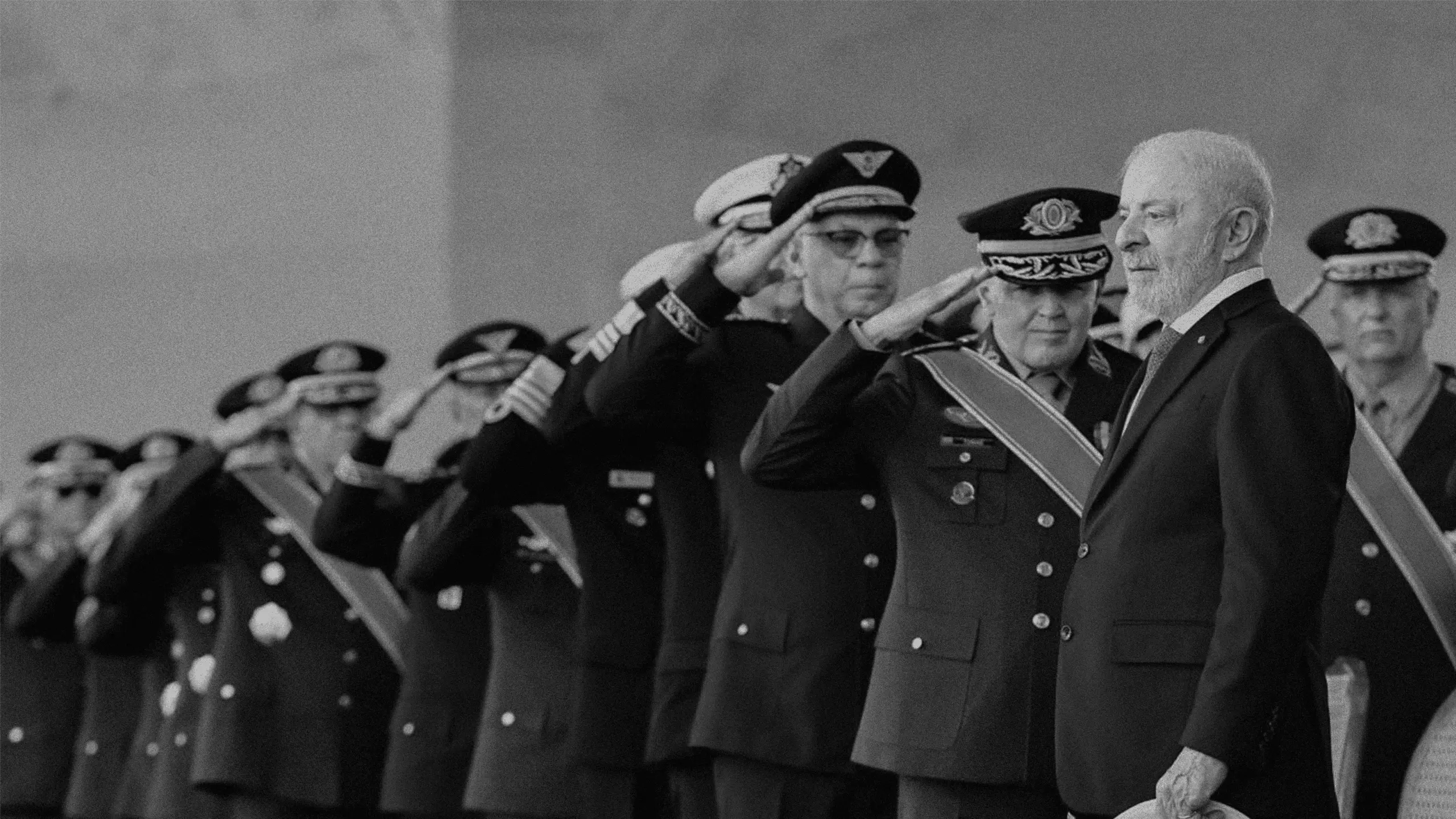
A psychological warfare operation is underway. This is no exaggeration: the Glossary of reactionary Armed Forces (FA) defines psychological warfare as the planned use of propaganda and other actions with the purpose of influencing the opinions, emotions, attitudes, and behaviors of opposing or neutral groups. In this case, the objective is clear: to “cleanse” the image of the Armed Forces High Command (ACFA) of their coup plotter label – which fits it perfectly. This is expressed in a flood of statements from high-ranking active-duty and reserve military officers aimed at “rewriting the history” of the FA contemporary coup plotters.
In April, when questioned about the impact of the conviction of generals involved in the Bolsonaro coup on the image of the FA, General Claudia Cacho responded by highlighting the “state and non-partisan character of the Army” (hilarious, isn’t it?). In May, she again stated that “politicization is bad,” referring to the barracks, and sought to distinguish “individual political opinions of military personnel” from the institutional position. In June, when asked whether coup-mongering had been overcome in the reactionary Army, she again defined the institution as “permanent and nonpartisan” and asserted that it was now fulfilling its constitutional mission, “as it always has” (even when, in 2022, it aligned itself with Bolsonaro to question the legitimacy of the elections?). Her words have an unintentional touch of humor. Macabre humor, of course!
To lend a veneer of credibility to this nonsense, the rhetoric didn’t stop there. In August, perhaps the most important piece of the psychological operation was the release of the book “I said no! – An anti-coup trench ,” by former Air Force commander Carlos Baptista Júnior. Yes, there was no room for modesty: he himself would be an anti-coup trench! In successive interviews, Baptista Júnior argued that he and the then-commander of the Army in 2022, General Freire Gomes, had been responsible for preventing a rupture led by Bolsonaro.
On August 19, retired Army General Sérgio Etchegoyen, the “enforcer” in Michel Temer’s impromptu government during the 2016-18 period, publicly stated to the CNN media monopoly: “There was no coup because the FA did not go along with it,” adding that the institution was “paying for what some military personnel did.” He also declared, “I do not believe in a coup plot.” Indeed, the logic is remarkable: there was no coup plot, but there was no coup because the FA didn’t join in; brilliant: the Armed Forces didn’t join something that didn’t exist! It takes decades and decades in military academies to master logical reasoning of such vast scope. To conclude, the following day, Hamilton Mourão stated that Freire Gomes – the democratic general, who said no only at the last minute – “sought to preserve the institution, the Army,” and questioned whether the investigated acts effectively constituted a coup plot.
This psychological operation, as we can see, has a lot to manipulate. It directly aims to retell the story, making it simple and comfortable. The story supposedly unfolded like this: Jair Bolsonaro supposedly “lost his mind” after his electoral defeat in 2022. Surrounded by some irresponsible aides, rogue military officers , and far-right fanatics, he allegedly tried to convince his commanders to embark on a military adventure, which was “completely out of the question” for the military commanders, due to “matters of principle”! These commanders, “faithful” to the Constitution, supposedly responded “no” without any hesitation or consideration for the proposal. An aberration in itself, after all, they were all supposedly upright, democrats in uniforms, very serious men! The Army and the Air Force, in particular, supposedly acted as strongholds against the coup, as unwavering protectors of the powerless Nation, safeguarding its fate!!! The blame would therefore fall on Bolsonaro and a collection of individuals who, by unfortunate coincidence, included generals, colonels, majors, members of the Special Forces, a former Navy commander, two former Defense Ministers, a former head of the Institutional Security Office, and the candidate for Vice President of the Republic – in addition to the president himself, a former Army officer – but never to the military institutions from which they all came, holding command positions, both active-duty and reserve, as inveterate members of Freemasonry and recalcitrant conspirators of this exotic entity.
If this story was true, Brazil would be an idyllic country, an Arcadia itself. Not at all! It became clear that the sinister plan didn’t go ahead because Uncle Sam said: no way! Biden had serious problems around the world and didn’t want more trouble in his own backyard! And it wasn’t just one or two last-minute opposing gestures: the US Department of Defense, amidst this crisis, held a meeting on Brazilian soil with its counterparts from the defense ministries of the subcontinent to make clear the US message of “commitment” to “stability” and “democracy.” Just like that.
***
The reality is that, despite Bolsonaro, long before his election in 2018, a preemptive counterrevolutionary offensive had already been unleashed , frightened by the reaction to the popular revolts of 2013-14 and in the form of a gradual military intervention, a military coup, but in a different way from that of 1964.
It is worth reiterating. The preemptive counterrevolutionary offensive, as this forum has characterized it since 2017, was unleashed by the ACFA and the hard core of the establishment (the most powerful sectors of the local ruling classes, subservient to US imperialist power) in the face of the danger of “insurgency,” as the Agrarian Revolution and the League of Poor Peasants (LCP) considered it back in 2007-08 . There were three reactionary tasks outlined: 1) to overcome the economic crisis by imposing counter-reforms – as were, in fact, carried out, namely, the “Labor Reform” with tanks in the streets of Brasília and the “Pension Reform” under Bolsonaro, in addition to many others to boost the bureaucratic capitalism of the country in general crisis; 2) Restructuring the old State through “moralization” operations, such as “Lava Jato,” and the increasing assumption of functions by the Executive branch and maximum centralization of power within it and by high-ranking members of the reactionary Armed Forces, as demonstrated in the Temer and Bolsonaro governments; and 3) to conjure up the Revolution, or, in their terms, “insurgency,” “social crisis,” “social chaos” – through these preventive measures, and to combat them as they arise, as was evident in the generalization of GLOs (Guarantees of Law and Order operations) and decrees that allowed the continuous use of reactionary Armed Forces. To that end, their preferred line was not – and never was – simply to repeat 1964 (a rupture of the constitutional order), but rather to impose a gradual military intervention, by coercing institutions through deterrence and blackmail—which proved effective to the extent that all other institutions became demoralized or were demoralized by them—as well as through the occupation of the State apparatus and the imposition of the fundamental directions of the political and economic order. In this course of, shall we say, step-by-step military intervention, overtly coup-like violations—when urgent to ensure the offensive’s progress—were to be limited and isolated, applying the preventive counterinsurgency principle of “minimal use of force,” based on Yankee counterinsurgency manuals, so as not to provoke popular resistance to the coup threat.
During Dilma’s impeachment, back in 2015, the offensive was launched. Already in command of the coup-plotting Army, a role he had assumed in February 2015, General Villas Bôas said that, faced with that crisis and calls for “military intervention,” the Army developed internal guidelines that “began to fill the external void.” These guidelines were based on three pillars that he would repeat throughout the period: “stability, legality, and legitimacy.” In a 2017 lecture, Villas Bôas, in full command, formulated this exceptionally clearly: “Our proposal is that the Armed Forces be silent protagonists .” It didn’t stop there. He explained that society should identify the military as a guarantee that problems would not exceed “certain limits” (which should be prevented through active yet “silent” intervention, and limits beyond which full-scale military intervention would be justified in the face of the “social chaos” caused by a popular insurgency), preserving security and allowing the country to “rediscover development” (namely, to once again boost bureaucratic capitalism in crisis). In his memoirs, Villas Bôas recounts that the political demonstrations (read: blackmail, threats), the participation of reserve military personnel, and the impeachment situation were matters “intensely discussed with the High Command,” with the purpose of keeping the generals informed and “ensuring alignment down to the lowest ranks and reserve personnel.” This is an admission that the military leadership acted as a political party of reaction, using “the lowest ranks” and “reserve personnel” as a force, its militancy, in addition to the right-wing, fascist, and far-right social base that they had been mobilizing all along, which was even sheltered by the ACFA at the gates of the barracks in November-December 2022 .
Bolsonaro undoubtedly represented a contradictory aspect of that counterrevolutionary offensive , its far-right extremist version, which began to challenge its leadership, but it was by no means the only avenue for military intervention. The psychological operation, as can be seen, seeks to attribute all responsibility for the coup to the extreme right, shielding the military right from discredit, under the guise of the Armed Forces’ “professionalism” and “impartiality.” These are preparations for a new phase of the counterrevolutionary offensive.
***
The current commander, Tomás Paiva, went to WW Talks in June and stated, when discussing the crises between the branches of government: “This is part of our democracy, the system of checks and balances, and we are not the ones who are going to solve this institutional problem. We are participants in it.” “We see that the system of checks and balances is capable of resolving the institutional crises that we have historically had serious ones.” These statements clearly indicate that the need for a tactical adjustment to the counterrevolutionary offensive—which had already begun and was facing a loss of momentum—was due to the fact that: 1) the military crisis of 2022 and the events of January 8, 2023, created a new situation, in that while the ACFA’s use of unrest in the federal capital served to send a message to the opportunist government about who is truly in charge, but also showed that the path of gradual military intervention had been exhausted; however, the message sent meant that its tutelage would remain latent; 2) it revealed, along with all the talk of “professionalism,” that the counterrevolutionary offensive would now have to shift to another path in order to continue and intensify—its “Plan B.” And this is the increasingly widespread use of the Armed Forces in counter-subversive warfare, with ever greater weight and a new legal and political order supporting it.
Therefore, the theme of “war on drug trafficking” has become, for over a year now, in view of the electoral farce of 2026, a sort of common rallying cry among the main candidates of the ‘Partido Único’
Take Caiado, for example. The feudal lord of the Midwest, and the public face of the UDR, is proposing a “Domestic Terrorism act” in which he intends to target groups linked to trafficking and exercising “territorial control.” Furthermore, he proposes a “National Command for the Protection of Borders and Logistics Corridors,” directly integrating the FA, PF [Translator’s note: Federal Police], PRF [Translator’s note: Federal Highway Police], FNS [Translator’s note: National Security Force], and State police forces for counterinsurgency war. Furthermore, the so-called “Operation Reconquista,” proposed by him, calls for the participation of the Armed Forces against “terrorist groups” without even requiring a GLO, with the aim of the much-touted “retaking of territories.”
Let’s look at Zema, the “bellicose” one: his “Relentless Plan” expressly calls for the use of the Armed Forces and federal agencies to “retake territories,” classifying organizations that exercise such “territorial control” as “terrorist organizations,” even suggesting that a military intervention in Rio could last 10 to 20 years (!). And there’s more: he proposes adopting the prison system of El Salvador’s notorious Bukele (a proposal echoed by others).
Now, Renan Santos, the Mussolini in sneakers: he advocates for a “state of defense” in areas dominated by such groups, GLO and “territorial recovery.” In addition, he actively declares that “a war” will be declared, with a distinct legal framework, treating “terrorists as anomalous beings to the State,” and advocating for the cessation of individual and democratic rights in areas under the operation of the Armed Forces and the police.
This is the new path the counterrevolutionary offensive will take. The ACFA (Armed Forces Armed Forces) believes it has not been able to fully and lastingly impose its counterinsurgency policies through the immediate restructuring of the political regime – having encountered resistance from the official political world during “Lava Jato” and, later, having lost absolute control of the offensive with the arrival of the far right in the presidential chair. Now, it will channel it into the strictly military field, hence its “technical,” “professional” language. Thus, the reactionaries think: immediately, they will impose a new order necessary for their counterinsurgency policy on the front lines, in armed combat. Thus, in perspective, they may regain “authority” and prominence, and soon, under better conditions of legitimacy, openly dictate to reactionary institutions the policies considered strategic to elevate their own counterrevolutionary war (called counterinsurgency by them), aligned with and subordinated to the plans of Yankee imperialist aggression against Latin America against “narcoterrorism” and, on this basis, to mediate institutional struggles within the ruling classes.
Ultimately: the more the demoralized political system (incapable of solving the most basic problems of the masses) transfers the resolution of its crises (such as the “drug trafficking problem”) to the Armed Forces, the more the Armed Forces reappear as indispensable to the very stability of the regime and the resolution of its structural problems. The next phase of the counterrevolutionary offensive will be to advance through counterinsurgency, counterrevolutionary warfare, under the pretext of drug trafficking; this is their Plan B following the events of January 8, 2023.
***
Finally, it would be very naive – or disingenuous – to imagine that such an apparatus will remain confined to so-called “organized crime” that exercises “territorial control.”
In fact, “territorial control,” this abstract concept, is precisely what characterizes the revolutionary struggle for land. “Terrorism” and “narco-guerrillas” are exactly epithets used by the PM-RO (Military Police of Rondônia) against the LCP (League of Poor Peasants) since 2007-08, and this rhetoric has recently intensified. The Yankees, in the subcontinent, declare war on armed anti-imperialist forces, just as the struggle for Agrarian Revolution in the country, especially in the Amazon, is anti-imperialist.
Counterinsurgency, the strategy guiding all actions of the Armed Forces since 2015 and their counterrevolutionary offensive, is not intended to combat “drug trafficking”– after all, it has existed for a long time, and while it is indeed deepening its presence throughout the entire country, it is implausible that it has not already long since surpassed the so-called “limit” drawn against the revolutionary struggle. Therefore, the current situation cannot be explained solely by the development of this actor. The “insurgency” that the reactionary Armed Forces seek to combat is the Democratic, Agrarian, and Anti-imperialist Revolution under the leadership of the revolutionary proletariat. It is the peasant war under proletarian leadership, for the seizing of power, which they were unable to prevent in its initial stages – the strategic objective is to annihilate it. Certain organizations linked to trafficking, while also being targets, are, from a strategic perspective, merely the scapegoats.