Bangladesh – Proyog: A Call on the 50th Death Anniversary of Chairman Mao Tsetung
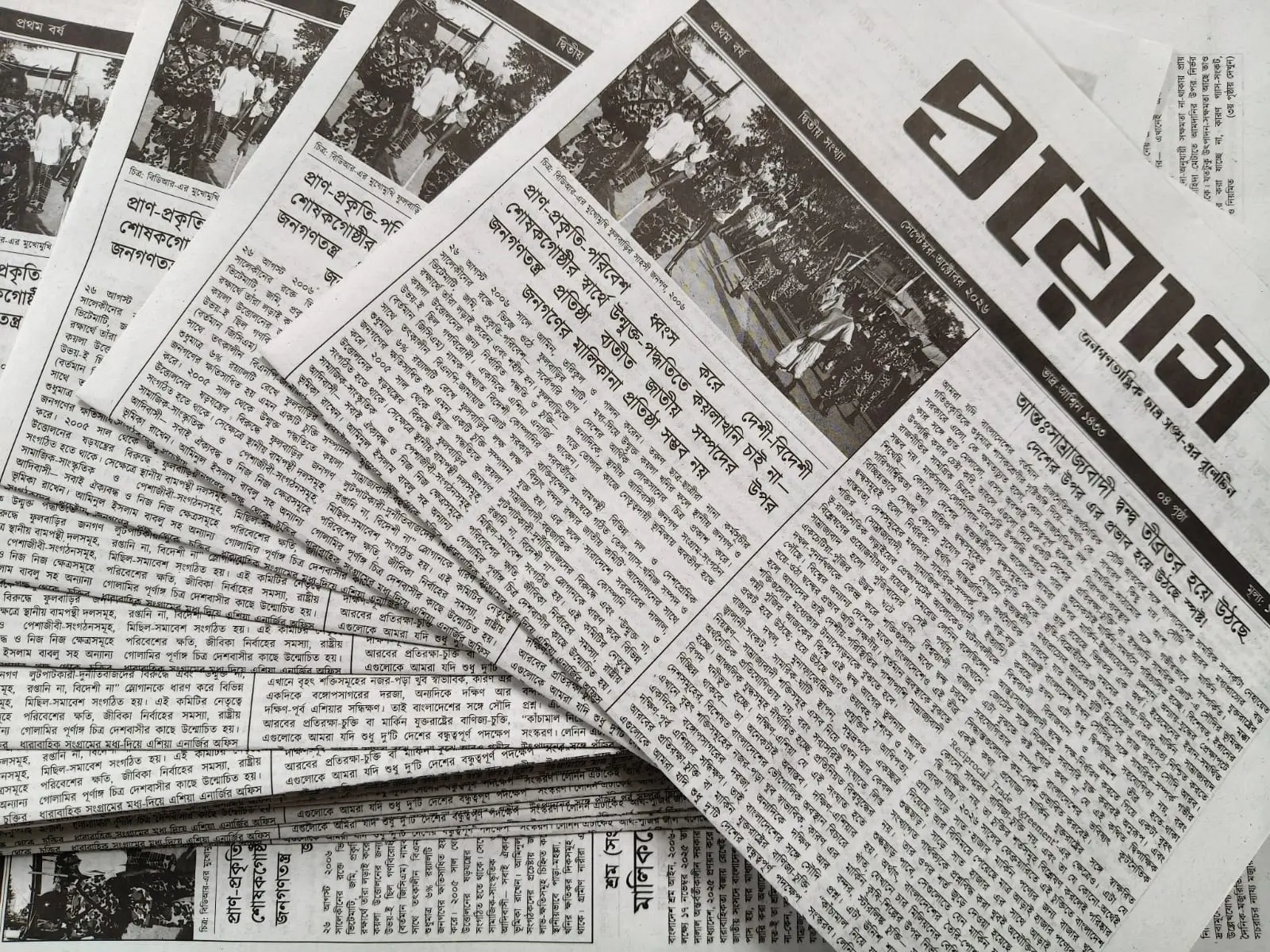
We hereby share an editorial of the September-October’26 issue of the bulletin of People’s Democratic Students Unity, “Proyog,” which we have received by email.
Proyog – Editorial Line : A Call on the 50th Death Anniversary of Chairman Mao Tse-tung, the Great Leader and Teacher of the Proletariat— Raise High the Great Weapon of Marxism-Leninism-Maoism
September 9, 2026— the 50th death anniversary of Chairman Mao Tse-tung, the leader and great teacher of the proletariat’s socialist world revolution. He was born on December 26, 1893, and on this day in 1976, this great communist passed away due to old age and illness. Through the creative application of Marxism-Leninism to the concrete conditions of China and, on the basis of the correct revolutionary line, through providing the workers and peasants, oppressed nationalities and people of China with the path to liberation, Mao Tse-tung and the Communist Party of China under his leadership qualitatively raised Marxism-Leninism to a new height. The Great Proletarian Cultural Revolution conducted under his leadership stirred the hearts of the liberation-seeking people not only of China but of the entire world; it provided the proletarian world revolution with direction for seeking and applying the correct revolutionary line. Throughout his life he devoted himself to the service of the proletariat, oppressed nations and peoples, and the world revolution; he was a genuine friend of the exploited and oppressed, of the working people, and a genuine enemy of the exploiting classes that appropriated labour and profit. Through every step of his revolutionary life, he taught that against the unjust system built by these exploiting classes, “rebellion against injustice is justified.” He further taught that— continuing to struggle until victory is achieved is the logic of the people. Through the People’s Democratic Revolution in China, the summation of the experience of socialist construction in the Soviet Union and its creative application to socialist construction in China, the political-ideological struggle against Khrushchevite modern revisionism in the international communist movement, and the process of the Great Proletarian Cultural Revolution, Chairman Mao Tse-tung achieved an unprecedented development of the fundamental aspects of Marxism-Leninism; as a result, we have received Marxism-Leninism-Maoism as the third and highest stage of its development, as a great weapon. Marxism-Leninism-Maoism is the Marxism-Leninism of the present era.
With the victory of the Russian Socialist Revolution, the democratic revolutions of the colonial, semi-colonial and semi-feudal countries became part of the proletariat’s socialist world revolution, and the world effectively became divided into two opposing camps— the camp of proletarian revolution and the imperialist camp. It was in this context that Chairman Mao Tse-tung developed the concept of a two-stage revolution in the field of class struggle through formulating the general line for the People’s Democratic Revolution in the colonial, semi-colonial and semi-feudal countries, that is, the countries oppressed by imperialism. Through formulating the line of protracted people’s war as the general strategy for revolution in these countries and applying it in the Chinese Revolution, he raised Marxist military science to an unparalleled height.
In conducting the struggle against the dogmatist and empiricist tendencies existing within the Communist Party of China at that time, Chairman Mao Tse-tung further developed Marxist epistemology and dialectics. In the field of Marxist epistemology, he developed the understanding of the dialectical relationship between theory and practice and brought forward the truth that “theory depends on practice and the basis of theory is practice, while theory also serves practice.” In this way, alongside opposing theory divorced from practice and reality, he also emphasized the importance of struggle against narrow empiricism divorced from the scientific summation of practice. At the same time, he formulated the mass line of “learning from the people and taking that knowledge back to the people.” In the field of Marxist dialectics, he clarified and systematized the law of “the unity and struggle of opposites” as the fundamental law governing the development of nature, society and thought. Thus, he played an important role in the development of the proletariat’s worldview, that is, dialectical materialism.
Even after the victory of the Chinese Revolution, when Liu Shao-chi and the capitalist-roaders following him advanced the revisionist tendency of giving primacy to the development of the productive forces over class struggle and the transformation of socialist relations of production, he conducted a resolute ideological struggle against it. At the same time, the negative experiences of socialist construction in the Soviet Union emerged as an important issue in the international communist movement. Chairman Mao Tse-tung summed up the experience of socialist construction in the Soviet Union and developed and firmly established the Marxist political-economic understanding of the laws and characteristics of class struggle in socialist society. He formulated the general line and policies applicable throughout the entire historical period of socialism. He firmly put forward that class struggle continues to exist in socialist society as well, and that the contradiction between the proletariat and the bourgeoisie is the principal contradiction in socialist society. As a path for socialist construction in backward countries, he emphasized transforming light industry into heavy industry on the basis of local resources. Again, in the changed reality of the era of imperialism and proletarian revolution, he exposed the nature of neo-colonialism and, in this context, identified the development of bureaucratic capitalism. After the death of Comrade Stalin, the capitalist-roaders seized power in the Communist Party of the Soviet Union under the leadership of Khrushchev, and when the Soviet Union subsequently became a social-imperialist state, the truth of Chairman Mao Tse-tung’s understanding became clear to the whole world. Observing the nature of the Soviet state under Khrushchev and his leadership, he declared that “the seizure of power by revisionism means the seizure of power by the bourgeoisie.” In opposition to the capitalist-roaders’ elevation of the “theory of the development of the productive forces,” he put forward the theory of continuing the revolution under the dictatorship of the proletariat. This theory created a profound response among large numbers of workers, peasants, students and youth in China, and it was as the historical outcome of this struggle against the capitalist-roaders within the Party and state that we find the direction of the Great Proletarian Cultural Revolution— through which Chairman Mao Tse-tung’s contributions became further clarified and Marxism, in his hands, reached an unparalleled height.
The capitalist-imperialist world system is today sinking ever deeper into crisis; the contradictions among the imperialist countries, particularly between U.S. imperialism and Russian-Chinese imperialism, are intensifying, and as a reflection of this, in various regions of the world, particularly in the Middle East and South Asia, their comprador forces are engaged in contradictions with one another over the establishment of hegemony. In countries like ours, oppressed by imperialism and semi-colonial and semi-feudal in character, the feudal and comprador-bourgeois classes, serving as imperialism’s agents, remain constantly engaged in exhausting the country’s resources, exploiting its labour power, appropriating superprofits, and advancing the interests of their masters and their own class interests. From time to time, under the pretext of “development” or “reform,” they in fact create the path for further plunder of resources or for carrying out even more naked rule and exploitation over the people. In countries like ours, through ‘parliamentary’ democracy, one section of the ruling classes engages in conflict with another section in order to displace it and secure the exclusive right to act as imperialism’s comprador. Even in the so-called ‘urban uprisings’ here, imperialist powers, particularly U.S. imperialism, continue their efforts to establish hegemony by appropriating the people’s legitimate grievances. Therefore, the lines advanced by revisionist-opportunist parties and organizations centered on ‘elections’ and ‘urban uprisings’ are not correct for countries like ours— rather, they weaken the correct line of accomplishing the agrarian revolution and People’s Democratic Revolution through protracted people’s war. Again, the Maoist-communist forces throughout the world and in our country remain dispersed. Revolutionary struggles in countries like ours, in particular, are repeatedly facing setbacks in the face of state repression. At this moment, therefore, the necessity of correctly applying the summation of struggles and the correct line on the basis of a higher understanding of the line has become increasingly urgent.
But without a correct theoretical foundation serving as a guide, it is impossible to correctly understand, adhere to and successfully apply the correct line, and this separation of theory from practice will inevitably pave the way for revisionism. Therefore, in the present era, we can never limit ourselves merely to nominally recognizing Chairman Mao Tse-tung’s contributions; rather, through deeply studying, assimilating and applying the scientific truths of Maoism, we must sum up the experiences of our past and present revolutionary struggles, conduct uncompromising ideological struggle against incorrect lines and deviations, and on that basis develop and apply the correct revolutionary line. Against all forms of left and right opportunism and revisionism, in this subcontinent Comrade Charu Mazumdar successfully constructed and established a political-military-organizational line centered on agrarian-revolutionary politics in the light of Maoism. The thunderous call of Naxalbari, that is, the line of protracted people’s war, continues to live on today in laying the foundations for the liberation of the people in our country and throughout the subcontinent. The 50th death anniversary of Chairman Mao Tse-tung is therefore not merely an occasion for formal remembrance or paying tribute; it is an occasion to raise the banner of Marxism-Leninism-Maoism even more firmly, to study and assimilate Mao’s revolutionary teachings anew, and to pledge ourselves to their creative application in the light of our own revolutionary practice.