EU State of the Union Calls for Increased Militarization and Shifts in the Temporary Inter-imperialist Alliances
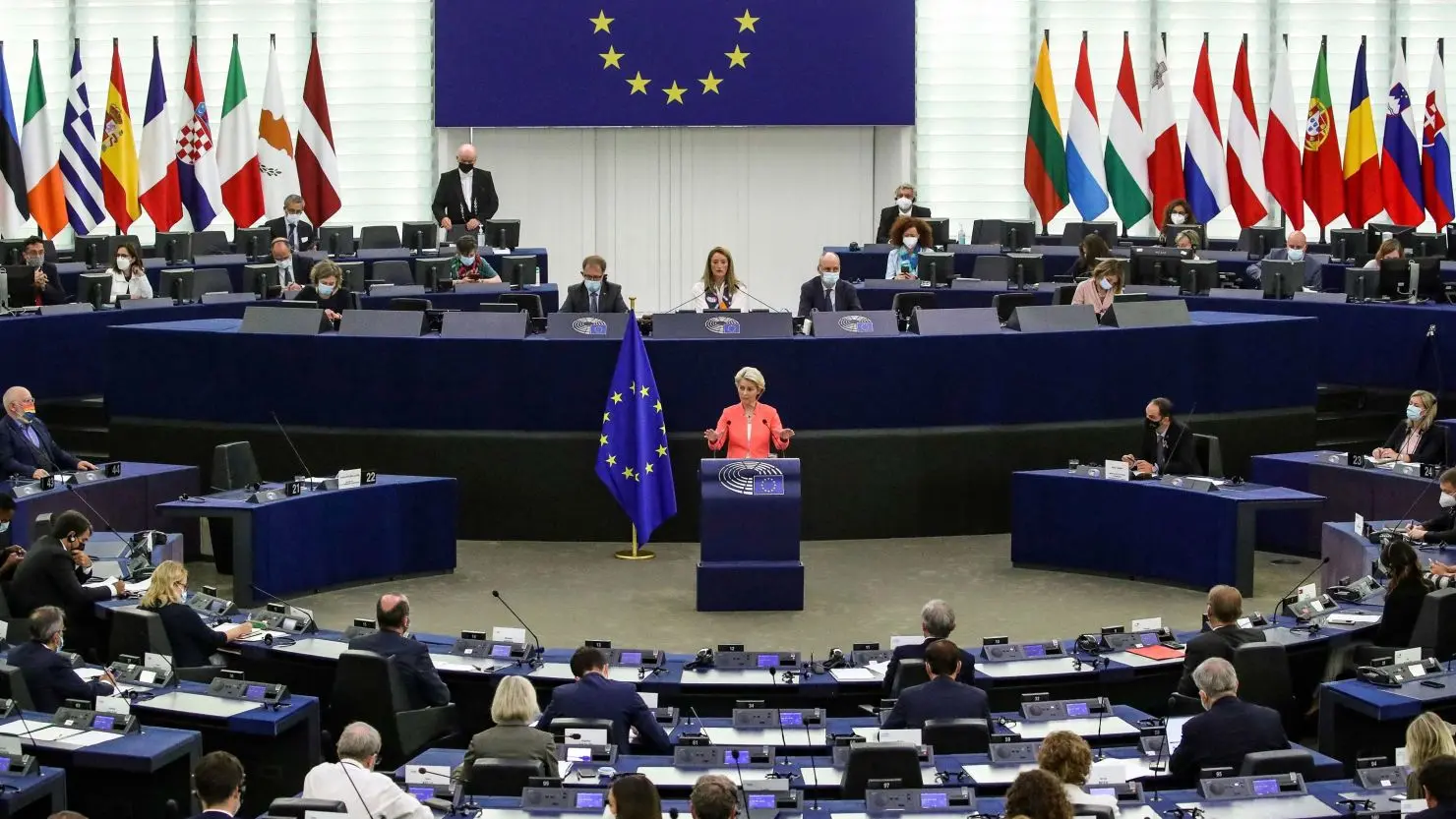
Featured image: President of the European Commission Ursula von der Leyen addresses the European Parliament plenary session. Source: CNN
On September 16, the State of the Union address – the annual speech addressed by the President of the European Commission to the European Parliament plenary session – was held by Ursula von der Leyen.
“It was the best of times, it was the worst of times,” is how Ursula von der Leyen chooses to open her State of the Union speech to the plenary session of the European Parliament this year, quoting Charles Dickens’ description of the times of the bourgeois revolutions in Europe. It is with an air of nostalgia she chooses to invoke the memories of a time where the bourgeoisie was fighting for a cause and for a principled set of ideas – before she returns to reality and expresses her proposal of the imperialist agenda that lies ahead for the imperialist States of Europe, appealing to the imperialist ambitions of all present.
Militarization is a recurring theme throughout the address, using as usual the war of aggression of Russian imperialism against Ukraine as pretext for why the European states must militarize. Drone episodes in various European countries are referred to as attacks “carried out by Russian operatives on European soil. […] against all of our Union.” Von der Leyen then calls for a way to circumvent NATO’s Article 4, and proposes an “Emergency Security Protocol,” which when triggered by one Member State would be convened on by all other Member States. In the same vein the European Security Council will be created, Leyen states, “focused on the security of our continent.”
Ursula von der Leyen also calls for taking militarization “to the next level,” unveiling plans to develop more air and missile defense, strategic transport, air-to-air refueling, space and cyber, going on: “That is why I can announce a new European Instrument for Strategic Enablers – fully aligned with NATO. Because only a strong and credible European defense posture will guarantee our security.”
At one point the increasing cost of living is highlighted – not to encourage a solution to be sought, but to point to internal enemies – and how “these real concerns are being weaponized to drive a wedge between us. […] and too often from the inside” von der Leyen paints an “internal enemy” for one to cast the blame for the crisis placed on the shoulders of the working class of Europe, while the source of the crisis – imperialism – is to be further developed.
Economically von der Leyen points to energy- and critical raw material independence as a pressing concern for the imperialist powers of Europe, pointing to Russia “cutting the gas” and the rising prices from the blockade of the Strait of Hormuz. Turning the European markets toward social imperialist China was also encouraged, with a caveat that European powers must find a way to exploit rare earth minerals for themselves, escaping dependency on the Chinese market, and in doing so the establishment of the European Corporation on Critical Raw Materials was announced.
In this years plenary, Canadian Prime Minister Mark Carney was invited. Leyen states as the reason for his invitation that “we must urgently reimagine our partnerships. And build global coalitions for our resilience and democracies.” Leyen states that Europe wants to develop further from the existing CETA, the trade agreement between Canada and the European Union, to develop an Alliance for the Future, with plans of developing cooperation on defense, technology and industry – focusing on energy, critical minerals, AI, and cyber security. Combined with the intention of moving further towards the social imperialist markets of China, EU seems to be making maneuvers in order to decrease their dependence on Yankee imperialism.
Leyen also addressed the massacre in Ceuta, callously using the murder of the migrants to call for the protection of “European borders”, blaming the migration on “traffickers” and “smugglers,” circumventing the fact that its the imperialist powers that have developed the bureaucratic capitalism that maintains the poverty, corruption, and political repression that cause these masses to seek better lives in Europe. Leyen uses Ceuta to call for the strengthening of Frontex and to propose an European Emergency Response Framework, which would allow for “time-limited and strictly defined flexibility in standard procedures” regarding “European border security.”
Ursula von der Leyen is right in one regard when alluding to the lost glory days of the bourgeois class – for we are in fact living in revolutionary times.