Brazil – AND Editorial: Expand the Popular Protest to Combat the Offensive of the Counterrevolution and Imperialism
We hereby share an unofficial translation of an editorial published by A Nova Democracia (AND) on October 29.
The election results – with a victory for the PT candidate, Luiz Inácio, with 51.79% of the vote, versus 48.21% for the candidate of the extreme right, Flávio Bolsonaro – hold some important implications. But before addressing them, it is necessary to highlight a fact that debunks the myths of this old democracy. In a system of mandatory voting, almost a third of the voting-age population has, since the 1990s, resorted to abstention, spoiling their ballots, or casting blank votes as a political statement—a movement involving tens of millions of citizens. This is not the behavior of the politically alienated, as the general chorus and the consensus, that is forged by the institutions of the old, corrupt State from top to bottom, in the official propaganda of the Superior Electoral Court (which boasts of being “The Justice of Democracy”), and in the writings of the established parties and media monopolies – in short, a consensus built by the defenders of this dying political system they call complete democracy. After all, it would be a strange form of political alienation on the part of the masses to abstain, wouldn’t it? Now, precisely to defeat the candidate of the extreme right in the second round, it was these millions of citizens who turned the election around, inspired and moved by the massive demonstrations across the country, many of them, as active participants in those demonstrations, denouncing the extreme right. Indeed, this tribune does not renounce its position of boycotting this electoral farce and this is what we will maintain in the following analysis of the election results.
Now, let’s begin by highlighting two of its implications.
First: The country, by a majority, said no to the project of the extreme right and the plan of Bolsonarism to reinstate their reactionary, anti-people, and treasonous regime, just as it said no to the US imperialist ambitions to so easily lay claim to our natural resources and station troops on our territory. This rejection, which goes beyond a rejection of the political system itself – which is quite a feat! – occurred even in an election riddled with interference from the Trump administration and machinations by the far right to prevent the free movement of voters and manipulate the outcome.
After all, let’s consider this: the rejection of Bolsonaro, according to the latest Quaest poll before the election, stood at 49% of the electorate, and 45% said they feared the return of the extreme right to government (the PT candidate’s situation was not comfortable on these same issues: 47% opposed him and 42% feared another term for him; in this sense, a portion of Flávio “Rachadinha’s” [translator’s note: “Rachadinha” refers to a part of the corruption committed by Bolsonaro, robbing parts of salaries of subordinates through several coercive and fraudulent manners and creating fake jobs for some of them] electorate also voted out of strong anti-PT sentiment, confusing the party with something left-wing and thus feeling drawn to Bolsonaro’s anti-communism). The Palver poll, conducted October 22–24, further clarified this picture: of the total votes for the PT, 34% were motivated by “defending democracy and rights” and 13% by “rejection of the Bolsonaro family” (47% of the total, nearly half, while only 18% would vote out of a preference for “Lula’s qualifications and experience”).
Thus, it is entirely false to give the PT credit for the result. It was an electoral defeat for the extreme right, but by no means does it represent any kind of renewed hope for the PT. On the contrary, the PT and Luiz Inácio emerge weaker than when they entered. First, because the promises, which were made recklessly just to win the election, will constitute the greatest electoral fraud in the history of the PT and will fuel the discrediting of the bourgeois left. After all, they would only be feasible if his government were to break several of its commitments to the international financial oligarchy and the big landlords, something that 18 years of government experience proves to be the opposite. But even if we admit that some self-criticism might occur in light of the desperate situation in which Luiz Inácio and the bourgeois left found themselves after the first round (and the popular outcry that massively shattered their policy of immobility and demobilization of the masses over two decades), even so, this is not the policy they are determined to pursue, because they view the masses merely as important spectators, there to applaud them and cast their votes. It is obvious that the president’s words in his victory speech about turning more toward the people, are not enough. After all, a break with those commitments would be a declaration of war on external and internal reactionary forces – something that social democracy, the opportunists, flee from like the devil flees the cross. Moreover, in this so-called “correlation of forces,” Luiz Inácio’s fourth term is facing a Supreme Federal Court (STF) that lacks credibility – not to mention that it is demoralized and divided, a Senate with a majority of members from the right or extreme right who are poised to take control of that body, and a strong presence in the Chamber of Deputies.
The second implication of the elections is this: they do not defeat the extreme right and fascism, as global history has amply demonstrated. The defeat of the extreme right in the second round of the elections merely postpones the decisive clash between the Brazilian people and the extreme right and fascism – a clash that will require many years (and even decades) of grueling and bloody struggles in the uninterrupted Revolution of New Democracy toward Socialism. Precisely because an electoral setback does not change the ideological nature of this force, nor does it crush, as is necessary, the politically organized forces of the extreme right and fascism. These forces are not found only in legal political parties and their representatives in the National Congress, in state and municipal governments, and in their respective legislative branches. The extreme right is present, ideologically and politically, at all levels of the judicial branch. It is solidly structured, as visceral and latent anti-communism, within the reactionary Armed Forces, civil and military police forces, private security firms, rural associations, and other organizations of big landlords; it is present among the CAC [translator’s note: association of legal owners of weapons] and in ultra-conservative churches. And many members of these institutions and organizations are, directly or indirectly, linked to a wide variety of semi-secret fascist and paramilitary groups, such as “Invasão Zero,” “militias,” “extermination squads,” etc. It also counts, particularly at this moment, on the support of Yankee imperialism and Zionist Israel, as the public face of its fifth column in the country, to advance absolute domination over Brazil and Latin America, which is an indispensable necessity for maintaining their respective status as the sole hegemonic superpower and as the Yankees’ forward base and spearhead in the Broader Middle East.
No matter how politically isolated the Bolsonaro clan may become in the country following its electoral defeat (with “01”’s withdrawal sounding like an admission of guilt regarding the charges of “criminal organization,” “money laundering,” “misappropriation of public funds,” etc., for which he is under investigation), it is not enough to stop them. The right wing’s anti-PT and anti-Lula stance continues to enjoy strong public support and still has the backing of Trump, who declared the election to be suspected of fraud. And it comes as no surprise to anyone that the election results are not being accepted, given Flávio’s public statements. It is worth noting that the fraud allegations found an echo on the international stage only with Milei and Trump; not even the majority of the governments of the extreme right of other Latin American countries paid heed to the defeated candidate’s outcry and, in accordance with protocol, congratulated Luiz Inácio on his victory. In any case, the new forms of the Yankee “hybrid war” currently underway in Latin America will not let up against Brazil, with the aim of empowering the extreme right and ramping up the tension and pressure. We’ve already seen the “Letter” sent from Miami, endorsed by the gusano Marco Rubio, in which Flávio proclaimed himself the offshore “leader” and “President” of Brazil. To that end, the Yankees will rely on various forms of unrest, including that from the extreme right, but not primarily in the immediate term, since there has been widespread outrage against it across much of Brazilian society and in Latin America, sparked by the massive demonstrations on the eve of the second round, following Flávio’s defeat, and above all, by the ongoing street demonstrations by masses of youth mobilized by combative forces and even by sectors of opportunism.
In the face of these inescapable events, the extreme right will find itself compelled to take advantage of the political system’s fragility and lack of credibility. The tendency is that, especially following the inauguration and start of the new administration and the return from the parliamentary recess, the extreme right will seek to deepen the climate of political instability and use all manner of maneuvers to push the institutional crisis to its limit and provoke further unrest in the streets. To this end, it will rely on its strong base in the Senate and the Chamber of Deputies, employing all manner of maneuvers there, such as voting to impeach Supreme Court justices and launching attacks, even if unfounded, regarding the manipulation of election results, while continuing to push all the allegations already raised during the election campaign. In this way, he also intends to provoke the well-known fluctuations in what bourgeois analysts cynically call “market sentiment.” In turn, this turbulent landscape will therefore be exploited by Trump to impose extremely harsh terms and conditions to “pacify” US-Brazil relations, thereby forcing the various factions within the new government to grapple with how to position themselves. Faced with pressure from the business world and the “market,” the new government will heavily emphasize a discourse of “dialogue” and “responsibility” – that is, appeasement and compromise – whether or not cloaked in evasive rhetoric about sovereignty. It is obvious that many of the forces that resolutely supported Luiz Inácio in the elections, and those who led the street demonstrations, will oppose the concessions demanded by the Yankees, and will not join the chorus of opportunism calling for submission to governability, as has occurred throughout the last two decades of PT governments, subordinating segments of the popular forces to the defense of the pact of class conciliation and collaboration. Thus, a division will deepen among the forces supporting the government: the discontent of the masses fighting against the extreme right, Yankee imperialist intervention, and the entire reactionary camp will be increasingly polarized by the revolutionary movement, that is present and active within the mobilized masses, which will make great strides.
Let’s see then. More than ever, the Yankees are interested in a government that is as subservient as possible when it comes to strategic issues. This is not a matter of preference, but rather an imperative necessity, as stated in their 2025 National Security Strategy. Therefore, these are the conditions. The terms would be that a future PT government would be peacefully acceptable to the US as long as it aligns with US foreign policy, hands over reserves of critical minerals, drastically reduces Brazil-China trade relations, and subordinates national Defense even further to the US Army’s Southern Command – to the point of normalizing US troop operations and military bases on Brazilian soil, under the pretext of combating “narco-terrorism”. That is in other words, implementing the essence of what a Bolsonaro II government would entail. It should be noted that Alcolumbre, an ally of the PT and current president of the Senate, already advocates for “pacification” at the cost of “recognizing Flávio Bolsonaro’s agenda”, that is, incorporating it. But let no one think that this is absurd to key sectors of the PT leadership and allies in the new government: now that the elections are over, they have already signaled a willingness to talk with Trump and renegotiate issues sensitive to Yankee interests.
***
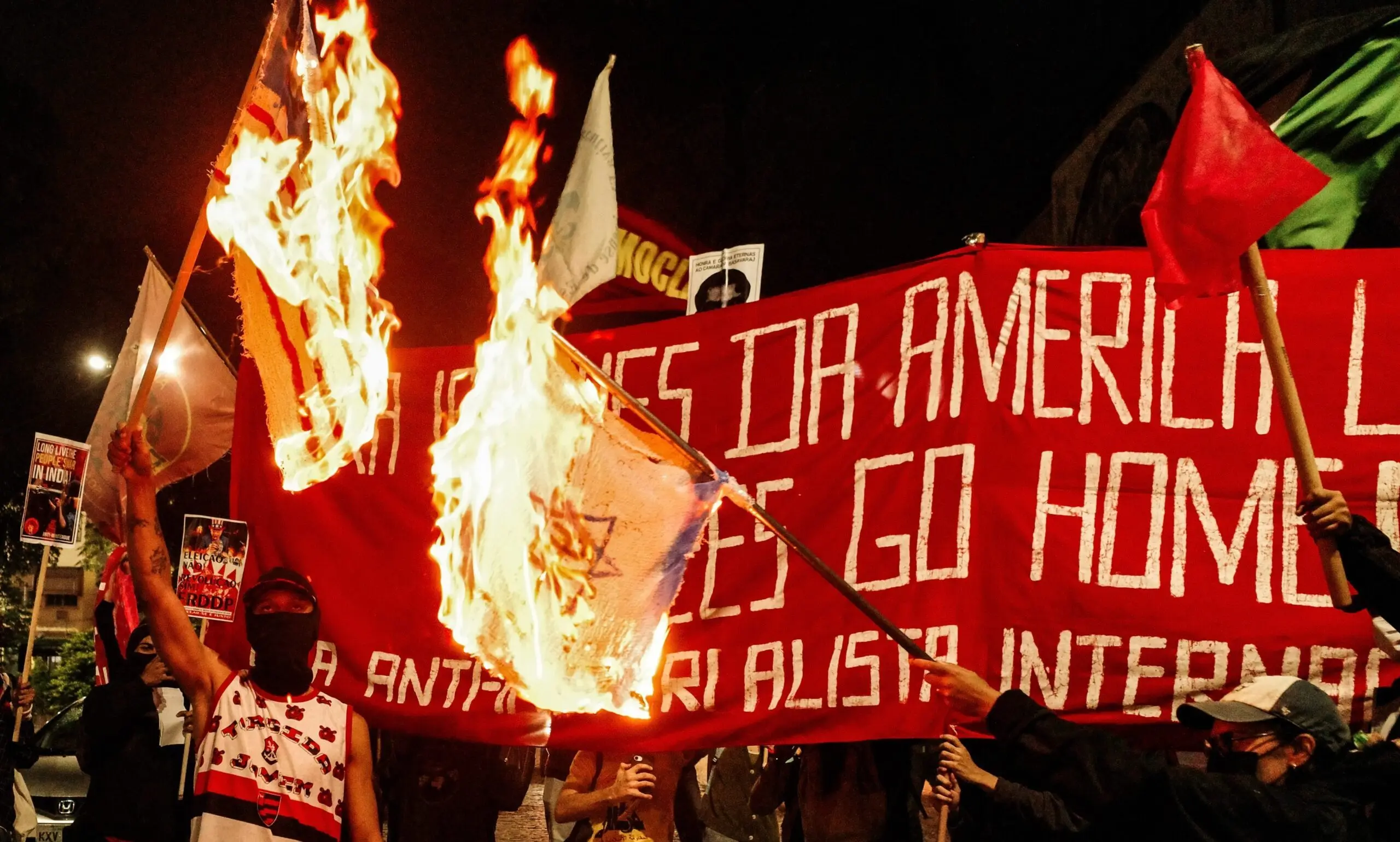
Therefore, the very least that the grave national situation demands of all forces within the popular movement, in order to combat the offensive of the counterrevolution and imperialist intervention in the country, and also to combat the tendency of the opportunist Social Democratic leadership to collaborate with the reactionaries and betray their own bases, is to raise the popular protest high. This is necessary for these two inseparable objectives: it is not possible to combat the counterrevolutionary offensive without combating the tendency toward vacillation among the opportunist “leaders” and unmasking them.
However, such a popular protest must not be limited to mobilizing the electoral base or strictly left-wing activism (which is important but insufficient to counterbalance the reactionary offensive): it is necessary to set in motion a large portion of the proletariat and, principally, the peasantry. This is only possible by radically raising the economic demands of the popular masses and mobilizing them through all the basic instruments of struggle (urban and rural labor unions and other peasant associations, etc.), the vast majority of whom are still trapped in the immobilizing straitjacket of opportunism. Furthermore, we must mobilize them by raising the slogans of the political struggle against the extreme right, imperialist threats and intervention, and the entire reactionary tide, in order to engage forcefully in the ideological struggle within society, in defense of democratic freedoms and the rights of the people. On this tactical front, the revolutionary proletariat and the mass organizations led by it must also wage an active ideological-political struggle against social-democratic ideology, against all ideologies of opportunism, compromise, and conciliation with the ruling classes, against every tendency toward immobility and fear of unrest, tendencies toward capitulation and collaboration with the enemy “in the name of dialogue and social peace.” Fight the counterrevolutionary offensive! Death to imperialism and fascism! Down with opportunist illusions and collaboration with the reaction!