Finland – Punalippu: Money for Armament, but not for the Well-being of Conscripts
We hereby share an unofficial translation of an article published by Punalippu on October 28.
The Ministry of Defense’s administrative sector has been allocated more than 6.3 billion euros in the 2026 budget; in 2027, this amount would rise to 7 billion euros, according to the government’s budget proposal. According to a news report published by YLE on June 2, Finland is spending 7.7 billion euros on its military this year. According to a parliamentary working group of the parties in the Finnish Parliament, spending is projected to exceed 14 billion euros as early as 2029, and in the 2030s, spending is expected to remain at an annual level of 14–15 billion euros. At the report’s release conference, Defense Minister Häkkänen emphasized that when discussing military spending, one must refer to amounts in euros rather than the share of GDP, because “only money can buy capability,” in other words, funding for the military must be secured regardless of the economic outlook.
A large part of the spending is on arms procurement, and also in the statements from the bourgeoisie the need for the acquisition of new weapons systems is repeated, for example systems and weapons needed for drone warfare. Notable recent procurements include the F-35 fighter jets and the David’s Sling air defense system purchased from Israel.
Weapons, weapons, weapons, that’s all the bourgeoisie seems to be paying attention to. But what about those who wield the weapons?
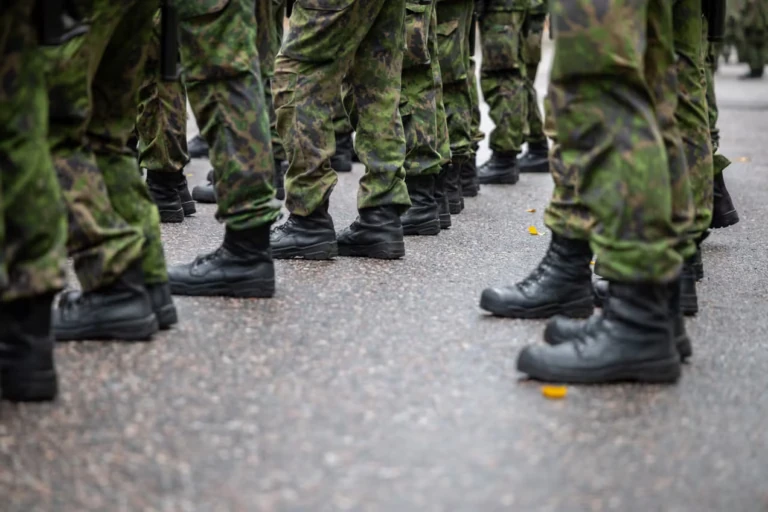
Conscripts’ daily allowance is currently 6.15 euros (1–165 days), 10.20 euros (166–255 days), and 14.25 euros (256–347 days), depending on the length of service. In addition, women performing voluntary military service receive an extra 1.50 euros for underwear and menstrual products, as the Finnish Defense Forces does not provide these items. Conscripts’ daily allowances rose by a whopping five cents in February 2026. Even convicts serving in open prisons receive higher daily allowances.
Especially for proletarian young men who have been working before serving, military service can mean a significant loss of income. If they are in a cohabiting or married relationship, the couple can lose a significant part of their income. Many have to resort to borrowing from relatives and scraping by.
In general, the defense budget has allocated 231 million euros for the training and maintenance of conscripts, excluding salaries, in 2026.
Conscripts, especially working-class youth, form the foundation of the Finnish army. They are required to give their lives for a State that spends billions on arms but does not even provide a income proficient for living. Conscription further worsens the situation, which shows that the issue of daily allowances is primarily a class issue. The outlook that awaits these young men in general is unemployment and growing a lack of perspectives and uncertainty, which are the consequences of an system of exploitation driven solely by the capital’s pursuit of profits.
Conscription itself already carries a danger of death: for example, an article published by Yle’s MOT program in 2024 stated that serious accidents occur in the Defence Forces every year. Maaseudun Tulevaisuus wrote in 2023 that since the 1990s, 28 conscripts have died in accidents, the most devastating being the sinking of a combat vehicle on Taipalsaari in 1991. Deaths from shootings are rarer, but they do occur. Accidents are often caused by carelessness or overly demanding training.
In addition to traffic accidents, the second most common cause of death for conscripts between 1990 and 2015 was suicide, according to Mtv. These statistics include deaths that occurred during leave. Mental health problems are the most significant reasons for interrupting service. According to the Defence Forces, interruptions are also increasingly related to coping, adaptation and substance abuse problems, and this generally reflects broader social development and the well-being of young people. These are expressions of the decay, mental and physical destruction of young people that imperialism, as a moribund system, promotes. The bourgeoisie, as a reactionary ruling class, spreads its own decay among the proletariat, imposing its increasingly reactionary ideology and entertainment, general lack of perspective, addictive social media algorithms that enrich technology giants, and numbing substances. The bankruptcy of capitalism is becoming increasingly obvious. The bourgeoisie has changed from a progressive and vital class into a reactionary, historically obsolete class, because the development of the productive forces has eliminated the scarcity that previously prevailed and made it possible for everyone to have an adequate livelihood, eliminating the historical justification for the existence of a separate owning class. Although society is based on social production, in which no individual can say of the result of labor that it is his private product, its ideology corresponds to extreme individualism, the realization of which is possible only for the small part that lives off the labor of others, that is, for the capitalist class.
Several conscripts have experienced constant illness, indoor air quality problems, colds and poor health services. In March, Iltalehti reported on a case in which a conscript said he was forced to do physical service in Santahamina, even though he was coughing up blood and had a fever of 40 degrees, because he could not get to a doctor. He states that several others also got sick and only received short exemptions. He also says that those who were sick were not provided with meals inside, but outside in the cold, and that the food ran out halfway through. The conscript criticized the indoor air in the barracks, the short exemptions and the difficulty of getting to a doctor. At the same time, when enormous resources are being put into the development of weapons systems and innovations and arrangements for destroying people, even such a fundamental problem cannot be solved!
The question is not whether the soldier should not have to endure even harsh conditions, or whether the problems would be solved with better compensation or better conditions. The generally poor treatment of conscripts and how little money is allocated to their care, and how little attention the bourgeoisie pays to improving the conditions of conscripts instead of the armament, shows how in capitalist society the proletariat is nothing more than a cog in the wheel of capital’s pursuit of profit – in addition to having to sacrifice its life to increase the wealth of others under the yoke of wage labor, it should also die for the “fatherland” in wars instigated by the rich to secure their profits in time of crisis. Imperialism is the last stage of capitalism, in which its contradictions are exacerbated to the extreme, and the imperialists argue about the redistribution of the world. It is a small number of imperialist powers that control finance capital fighting among themselves to subjugate the vast majority of the world, a fierce struggle for control of natural resources, markets and spheres of influence for the pleasure of a small number of shareholders. This is why imperialism means war.
The fact that so little attention is paid to the well-being of conscripts already during their training reflects how little the bourgeoisie cares about sacrificing millions to protect its narrow interests. Why should these young people endure miserable conditions and even give their lives? Because of unemployment, growing lack of perspectives and uncertainty? Contrary to what bourgeois politicians constantly repeat, not everyone is doing poorly: capitalists are getting richer. In Finland too, wealth disparities are growing, and the richest 10% own more than the poorest half (2023). This tendency is not diverting.
Imperialist wars are wars of the rich, in which those who have had no part or lot in preparing and starting that war are sent to their deaths. Conscripts, despite all the celebratory speeches, are mere cannon fodder for the Finnish imperialist bourgeoisie. At the same time, this is precisely its destruction: wars are not won with weapons, even if the bourgeoisie claims so, just as production cannot run without workers. The bourgeoisie has created its own gravediggers, brought them together and enabled them to organize. We live in times of war, and war is an inevitable perspective. However, the question is the class nature of war, whether it is a just or unjust war, a war to preserve the power and exploitation of the bourgeoisie or to overthrow it.
The 20th century saw several revolutions in which millions of people, men and women, went to war for socialism. A significant milestone was the October Revolution in Russia in 1917, where the exhaustion of the masses during the imperialist world war played a significant role in the broad masses joining the revolution. Similarly, in the Second World War, millions took part in the defense of the working-class state against Hitlerite fascism and its allies, such as Finnish imperialism; in China, the communists, by correctly applying the united front tactic and waging a protracted People’s War, expelled the Japanese invaders from the country and finally defeated the Chinese reaction, establishing the People’s Republic of China. People’s Wars are still ongoing in Peru, Turkey, India and the Philippines, where the masses, under the leadership of the Communist Party, are striving to establish a new government in order to build a new society free from exploitation. Even in these revolutionary wars, many have given their lives and the working class has paid high tuition fees, as, for example, in Finland in 1918. Reaction does not hesitate to use the most brutal terror to maintain its power. Despite this, many join the ranks of the revolution, ready to defy death and prison, convinced of the destruction of the imperialist system, for the reason that these are wars for the seizure of power by the working class and the abolition of exploitation, for the construction of a new society. Concretely, this means the abolition of private property, the seizing of the means of production into the hands of the dictatorship of the proletariat and the real realization of the social nature of the productive forces, that is, that work no longer enriches a few individuals, but serves the well-being and development of society.
The crisis of imperialism is deepening and the imperialists are sharpening their butcher’s knives. They are unable to resolve their crisis. In their desperation, they are launching new wars against oppressed nations, wars in which they are unable to achieve their goals. The threat of war hangs heavy over the world. Recently, sabotage has been seen in Europe, most obviously by Russia, in an attempt to warn the European imperialists against supporting Ukraine. At the same time, the European imperialists are preparing war more and more openly and are calling on the masses to prepare for it. At the same time, as private consumption stagnates as exploitation grows, that is, as the masses become poorer and inflation soars as the imperialists pass the cost of their wars onto the masses, the arms industry is making unprecedented profits. However, the prospect of a world war terrifies the bourgeoisie: it knows that such a war would not enjoy the support of the masses, it would mean nuclear war and the complete destruction of some imperialists, and for this reason it is trying to avoid it to the last detail.
The question is therefore what to fight for, what to live and die for: the blue cross flag of reaction, which signifies growing exploitation and misery, or the red flag of socialism. The working class has no fatherland, for its interests as an international class are shared, although the bourgeoisie tries to elevate nationality and ethnicity as a distinguishing factor for people in order to protect its own power and in its own competitive struggle with other imperialists. However, this is not in the interests of the workers, for its interests are opposed to those of the bourgeoisie; the bourgeoisie achieving a stronger position in relation to its competitors is, first of all, at the expense of the workers and does not improve their position except at maximum by increasing the amount of crumbs that the imperialist bourgeoisie throws at it.