The Peasantry Struggles Against Dispossession in Honduras
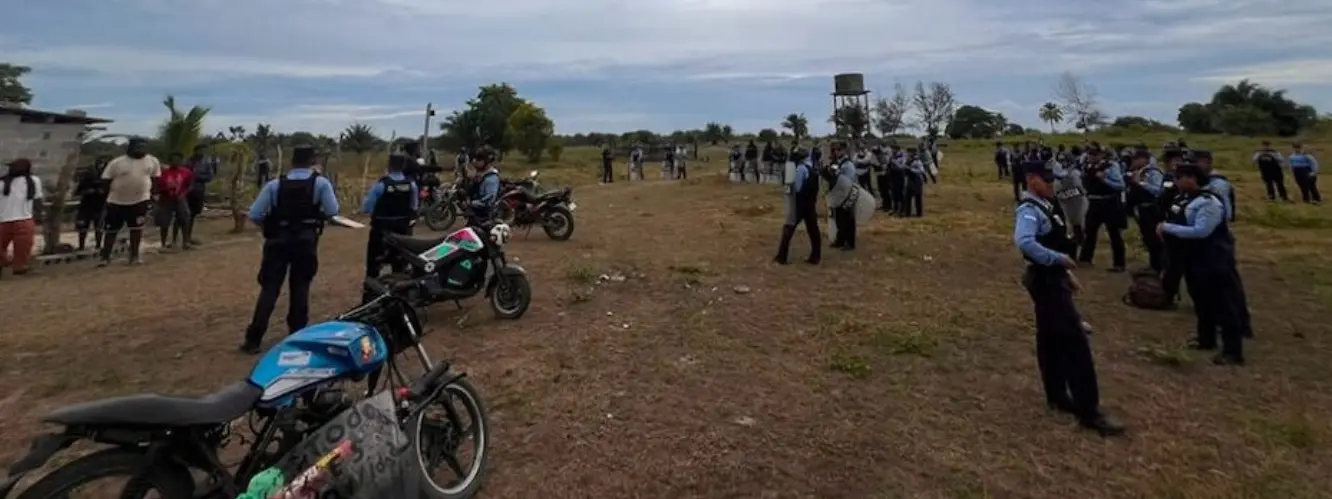
Featured image: Police deployment in San Juan Tela, Honduras. Source: Biodiversidad.
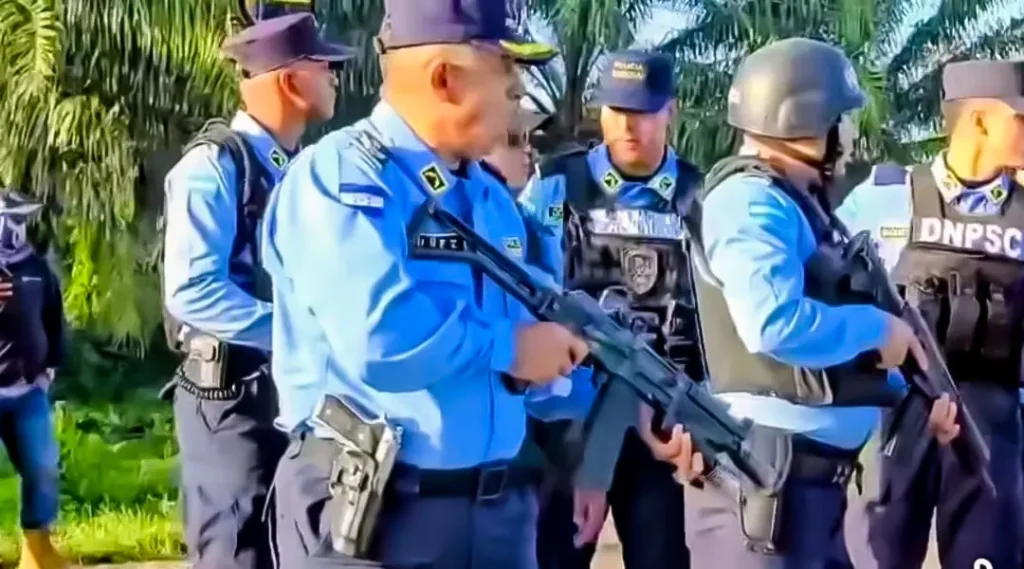
On the 6th of July, indigenous Garifuna peasants were evicted from their land in San Juan Tela. The eviction was carried out by more than 200 heavily armed police officers who carried assault rifles against the Garifuna indigenous peasants. In its assault on the peasants the repressive forces used live ammunition and tear gas, which has been denounced. At least five members of a local organization were arrested and several inhabitants were threatened and injured, including children.
These evictions must be understood in the framework of the sharpening of the struggle for land in Honduras, which has led the Honduran government to approve a new law, which seeks to criminalize the peasant protest, to target peasant occupations, and defend the big landlords’ and monopolies’ ownership of the land in the country. The law protects the lands dedicated to “agri-industrial” purposes as well as the land used for extracting raw materials. The Minister of the Agrarian National Institute (INA) stated that with this new law, the occupations “will be evicted in two or three days”. The State approved as early as in 2017 a law, which deems all protesters/demonstrators “terrorists,” Using the war against “crime” as a pretext.
Recent reports point out that in 2025 there were “77 active conflicts related to land, natural resources and territorial rights, concentrated in 13 provinces and related to the agrarian sector”. More than 80% of them are categorized as high-intensity conflicts, with ongoing trials, eviction threats, and clashes.
The big landlords have commonly formed paramilitary groups in the Bajo Aguan area, attacking the peasants in an attempt to evict them and grab the lands. A Nova Democracia (AND) recently reported that 20 peasants were executed in the Bajo Aguan area on the 21st of May. The big landlords are trying to suffocate the peasant resistance in the area, which takes place against the monopolies and the State in their service. At least 446 people have been violently murdered in land related conflicts in the country between 2014 and April 2026.
Honduras is a semi-colonial and semi-feudal country, where bureaucratic capitalism unfolds impulsed by imperialism, mainly by Yankee imperialism, the sole hegemonic superpower, which has had a tight grip on the country since the beginning of the 20th century until now. According to the figures of 2025, Yankee imperialism was the biggest foreign exporter of capital in the country by a wide margin. There is a clear concentration of land in the country, which is also the main tendency: according to the latest available statistics provided by the Honduran State this year, there are 408,965 owners of land in Honduras: 99.7% are peasants, the rest of them are companies and the government. Other data from a report made by the Autonomous National University of Honduras (UNAH) shows that 75% of the lands are owned by less than 20% of the land owners.
Palm oil is today one of the main export products of Honduras, and the plan of the foreign monopolies is to expand the plantations to at least 650,000 hectares (today Honduras has 1.1 million hectares of productive land) and make Honduras the main palm oil exporter of Latin America. The semi-feudal and semi-colonial character of the country leads to a crippled economy which sinks the Honduran people into poverty: the majority of the population of Honduras is considered rural, and 70% of it is living under extreme poverty, with at least 3 million inhabitants live under food insecurity, according to data from the government itself.
The dominance of Yankee imperialism has a long history in the country: since the beginning of the 20th century many Yankee monopolies arrived, mainly banana monopolies, which marked the beginning of the Yankee interference in the politics of the countries of Central and South America (colloquially referred to as “banana republics”). United Fruit Co. (UFCO) led several coups and ruled the politics of Honduras. At the beginning of the 1930s, the UFCO owned millions of hectares in Central America and Honduras was one of the main banana exporters in the world.
The dominance of the US monopolies and their harsh exploitation was contested by the massive strike in 1954, with which the struggle of the Honduran workers and peasants raised a challenge against Yankee imperialism. From the 70s onward, a period of more open repression started in the struggle for land. Starting with the massacre of La Talanquera, where 70 peasant families occupied unproductive lands, and at least six peasants were murdered by the State repression. In 1975 the Honduran State also kidnapped, tortured, mutilated, and murdered several peasants protesting in a national march. In the 80s a US military base was established in Palmerola, from where counterinsurgency campaigns were planned and executed, and the government was used as a reactionary support base for the counterrevolutionary Yankee plans. This military base (Soto Cano) is still active and remains important for the Yankee plans of attempting to impose its domination over Latin America.
The Garifuna or Garinagu people are descendants of African slaves and indigenous Caribbean peoples, and are present mainly in Honduras, Guatemala and Belize. There are Around 600,000 Garifuna people,they first arrived in Honduras at the end of the 18th century. They have their own language, culture, and a history of struggle for their right to live on the land they work. Currently they struggle against the expansion of tourism, agri-industrial and infrastructure mega-projects and face constant attacks by the Latifundium and the State. Honduras is the second-largest palm oil producer in Latin America, behind Colombia, with about 193,000 hectares of land under cultivation, particularly in the provinces of Atlántida and Colón, which have been the largest producers since 1940. The president of the Industrial Association of Palm Oil Producers of Honduras, Héctor Castro, stated that most of these are owned by the company Palmas Atlántida, which belongs to the Litoral group, a society of producers that has been denounced by the Garifuna for “owning lands of dubious origin”. Land purchase agreements on Garifuna territory have been supported by imperialist institutions such as the World Bank and the International Monetary Fund (IMF). Other agencies, such as the Inter-American Development Bank (IDB), have also provided loans to expand plantations in the area. The territory has also been infiltrated by criminal groups that transport drugs via the coast.
The struggle carried out by the Garifuna peasants has a long history. In the 70s Honduras launched its “agrarian reform” project, intensifying the land-grabbing and potentiating the concentration of land in the hands of the national big landlords and in the hands of international monopolies. The Garifuna groups living in San Juan Tela struggled against the Tiburcio Carías Andino Dictatorship, and as a result of this resistance, the Honduran State massacred 19 indigenous peasants in Durugubuti. With the coup and new government of Juan Orlando Hernández, the attacks on the Garifuna indigenous peasants increased. Since 2014, members of the Black Honduranean Fraternal Organization (OFRANEH), which defends the rights of the Garifuna peasants, were faced with at least 70 attacks, among them evictions in several of their territories, as well as 11 judicial procedures against their activists. Since 2018, more than 150 Garifuna peoples have been killed, 37 criminalized, and five forcibly displaced. There have also been forced disappearances by the Honduran State: on July 18th, 2020, five peasant leaders, four of them Garifuna leaders, were kidnapped by agents dressed in police uniforms – they never appeared again. The Garifuna have created their own organizations to search for their disappeared, creating the SUNLA Committee (which means in the Garifuna language, “Enough!”). The disappeared were part of the OFRANEH organization.
Once again we see how bureaucratic capitalism brings nothing but dispossession, poverty, exploitation and oppression to the oppressed peoples and nations. The people of Honduras in general, and in particular the poor peasantry, have been struggling against the local ruling classes and their State, and the State’s Yankee imperialist masters and latifundium for decades, making clear that the main problem in the country is the question of land. Despite the brutal massacres they faced, the Honduran peasants in general, and the Garifuna indigenous peasants in particular have not surrendered, and they won’t do so.