Colombia – ND: Abelardo Announces Persecution and Criminalization of Migrant Workers in Colombia
We hereby share an unofficial translation of an article published by Nueva Democracia (ND) on September 15.
Last Sunday, August 23, the president of Colombia, US citizen Abelardo de la Espriella, announced the launch of operations targeting “illegal immigrants—first, those who are committing crimes; second, those whose immigration status is not in order, who will eventually have to be deported.”
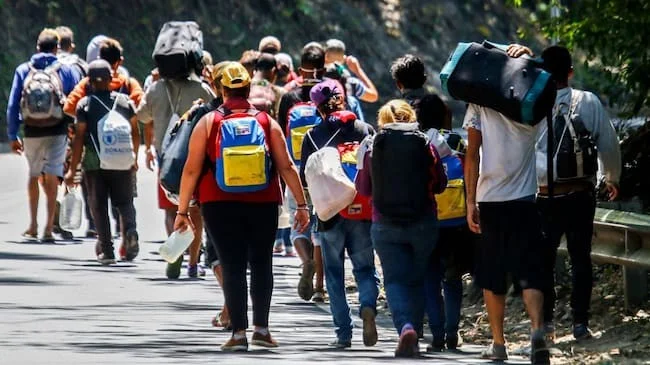
Although De la Espriella did not mention any particular population group, the reality is that 2.8 million Venezuelans live in Colombia, and this population accounts for 90% of all immigrants in the country. According to Migración Colombia, some 848,000 of them do not meet the documentation requirements set by the government.
These data lead to the conclusion that, in practice, the hostile attitude and practices toward the migrant population being promoted by the Colombian head of State leave Venezuelan workers in the country particularly vulnerable.
Meanwhile, no concrete action plan has been announced to address the phenomena of sex tourism and gentrification caused by the “Passport Bros”—that is, travelers from wealthy countries who seek out women, girls, and boys in colonial and semi-colonial countries. This phenomenon degrades and undermines the dignity of the Colombian people and clearly constitutes a form of criminal migration.
Thanks to social pressure—including protests, investigative journalism, and pressure on social media—some pedophile criminals, particularly those from the United States who come with the intent of engaging in sex tourism, have been denied entry. However, neither the previous administration nor the current one in Colombia has shown any interest in addressing the factors that lead to the country being promoted worldwide as a massive brothel for men from the “first world.”
Rather than addressing the issues that truly matter to the people, De la Espriella demagogically accompanied the announcement of this anti-immigrant order with the slogan “Colombians first, Colombians second, and Colombians third”—a display of chauvinism that, in reality, contradicts a truly national and popular immigration policy.
Persecuting Venezuelan immigrants in the country may cause more division than unity within the nation, because it entails the fragmentation of family and interpersonal ties that the Colombian and Venezuelan people have forged in both countries over many years, due to their shared cultural and historical roots.
Hypocritically, the announced crackdown ignores the fact that Colombia is one of the leading exporters of migrant labor in Latin America. Between 2022 and 2025, net outflow—that is, the one-way departure of Colombians—has grown steadily and rapidly, reaching 1.4 million people.
It is worth noting that 73% of those who have left Colombia between 2012 and 2025 are of working age, between 18 and 59 years old. In particular, young people between the ages of 18 and 29 account for 35% of net outflows during the period in question. Furthermore, the United States and Spain are the main destinations for Colombians leaving the country.
In the United States, an imperialist power, Colombians face State-sanctioned racism promoted by Trump. And, similar to Colombians and other Latin Americans in the US, migrant workers in Spain—primarily those of Arab origin—are also exposed to the racism that the ruling classes promote to divide the people.
These are not trivial facts. They are consistent with the migratory dynamics inherent in capitalism and imperialism, whereby the migrant workforce from oppressed nations is exploited to meet the demand of the oppressor nations in the lowest-paying sectors of those countries’ economies. The migrant’s subordinate position in the relations of production of the imperialist centers goes hand in hand with racial stigmatization and criminalization at the political and ideological levels, which are increasingly promoted by the ruling classes.
Rather than mechanically emulating the repressive policies of reactionary sectors in the North, Colombia needs to build, through revolutionary means, a solid economic and social foundation so that the working class can commit itself to the struggle against imperialism and for national development. A just immigration policy must strengthen the unity of the Latin American peoples rather than fragment it.
When Abelardo states that the crackdown on immigration will target “first those who are committing crimes, and second those whose immigration status is not in order,” he is simply repeating, word for word, the way in which Donald Trump—his president—and the xenophobic far right in the wealthiest countries have sought to legitimize imperialist State racism in the eyes of the public in those countries.
The fact is that, by establishing this hierarchy of how dangerous immigrants are, they are not only saying that undocumented migrants with criminal records will be prioritized, but that everyone—both those with criminal records and those without—will at some point be targeted by repression.
The conflation of immigration status—which is often a fundamentally bureaucratic matter—with the issue of criminality is also part of the paradigm for addressing the immigration issue imposed by Yankee imperialism.
The tendency toward greater reactionarization of the States that manage an economic and social system in crisis—such as imperialism—implies, precisely, that issues that were once handled administratively are progressively addressed as security problems, with a view toward the militarization of the State against the people.
Colombia’s obedient adherence to imperialist directives was confirmed by the recent visit to the country by US Secretary of State Marco Rubio, the son of Cuban immigrants and a bitter anti-communist. As a result of the meeting, the Barranquilla Agreements were enacted, which stipulate a path for the Colombian State to “responsibly submit to efforts aimed at ensuring regional stability and “deepen cooperation on border, migration, and security matters,” in the words of Abelardo.
It is worth noting that, despite appearing to be merely a mechanical imitation of the anti-immigrant racist policies of the North, the fact that the Colombian State, in its semi-colonial condition, seeks to align its immigration system with that of the United States is not merely a blunder.
Historically, as part of the Monroe Doctrine, the migration policies of Latin American States have served US interests. The repression of migrants in transit countries for international workers, such as Colombia and Mexico, serves precisely to stem the flow of people arriving in the US1.
The consolidation of a repressive policy against a segment of the working class in the US and its extension throughout the hemisphere—as part of US imperialism’s efforts to protect its interests in the region—suggests that the ruling classes are on the defensive, desperately seeking to fabricate contradictions within the working class to ward off the intensified class struggle that is constantly fueled by the economic crisis and political instability that the progressive deterioration of the global imperialist system has brought upon the world.
1Nicholas de Genova et. Al. (2026) The Borders of America: Migration, Control, and Resistance across Latin America and the Caribbean.