Netherlands: New Year’s Statement 2025
We hereby share an unofficial translation of a statement from the Communist Committee of Netherlands.
Editor’s note – Communist Committee of the Netherlands (CCN)
This statement is more extensive than usual. The past year has not been a normal political year. Wars are being supported more openly, repression is becoming easier to justify legally, and confidence in the political system continues to crumble. At the same time, resistance is growing and direct action is increasing. The CCN considers it necessary to interpret these developments in a coherent manner. A short text would not do justice to what is at stake.
We are starting the new year without any illusions.
The past year brought no peace or recovery, but rather more tensions. The gap between politics and the population widened, discontent grew, and repression became visible and was used. What had been simmering beneath the surface for a long time became openly apparent.
The elections confirmed this picture. The high number of blank votes was not indifference, but a clear refusal to continue to legitimize a system in which voting changes nothing. War politics continue, the housing crisis persists, work is becoming more precarious, and repressive measures are increasing, regardless of who is in power.
It is no coincidence that these elections solved nothing. The parliamentary system is functioning as intended: it maintains the existing order. Against this backdrop, there is talk of a new leading coalition of D66 [Translator’s note: Party “Democrats 66”], VVD [Translator’s note: People’s Party for Freedom and Democracy], and CDA [Translator’s note: Christian Democratic Appeal]. This is not a fresh start, but a repeat. These are the same parties that have pursued neoliberal policies for years, legitimized wars, dismantled social services, and expanded repression. Their cooperation does not serve the people, but rather secures the system.
The elections thus reveal two things. Rejection of current politics is growing. At the same time, there is no organization that can translate this rejection into real change. The problem is not that people do not understand or feel anything, but that there is no revolutionary party that can channel anger and insight and give it direction.
Palestine became the central flashpoint this year. The genocide made it clear that imperialism is not something that happens far away from us. The Netherlands is also involved through politics, businesses, universities, and institutions. Attempts to cover this up with diplomatic language failed completely.
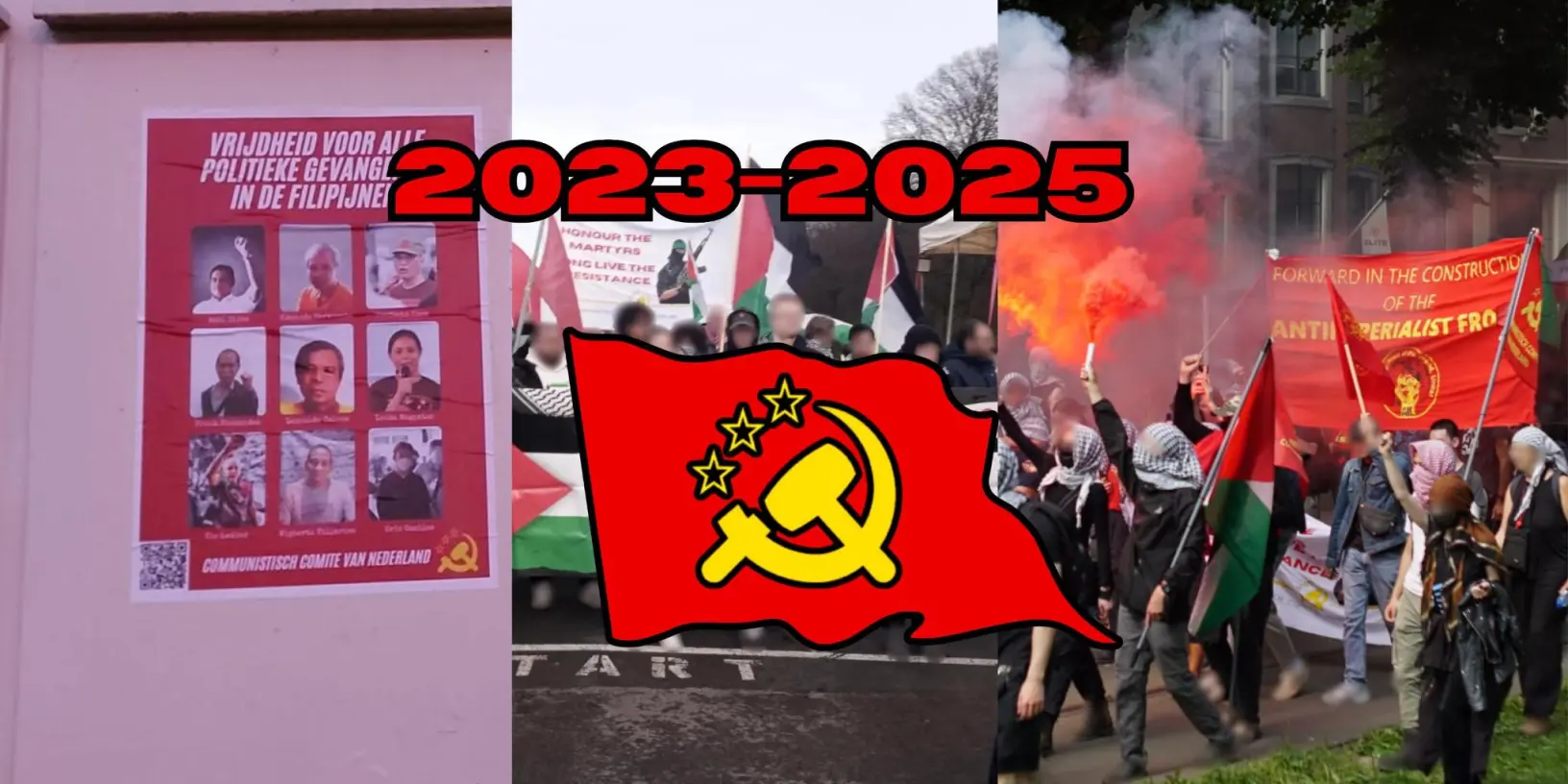
That is why solidarity was not limited to demonstrations. Universities were occupied, logistics were disrupted, and institutions were directly confronted with their role. It was not about visibility, but about breaking the normal course of events. Solidarity became active and confrontational. That is an important development. Palestine thus drew a clear line between those who dare to confront the system and those who perpetuate it.
The state’s response was predictable and instructive. Repression increased, surveillance and control were expanded, and solidarity was criminalized. This manifested itself concretely and publicly.
In July, the police raided our comrade’s house without warning. It was early in the morning, and they were still in bed. The police surrounded the house, handcuffed them, and took them away. The comrade had not used violence, had no weapons, and posed no immediate danger, but had issued a political statement denouncing the role of Dutch companies and institutions in war and oppression. What followed was eighteen hours of detention and then court cases aimed at discouraging further action. Conditions were imposed on the case, including that the comrade was no longer allowed to come near companies involved in arms production and logistics to war zones. During the trial, he was sentenced to 40 hours of community service, less than the normal 60 hours but still an escalation of repression.
This arrest and prosecution were not isolated incidents. They are examples of how the state uses not only police action but also the justice system and courts to suppress political struggle.
This year, repressive intentions were also laid down in policy proposals and legislation. The outgoing cabinet announced its intention to ban face coverings at protests. This means that people who cover their faces for fear of repercussions could be prosecuted. At the same time, blockades and disruptions will be subject to heavier penalties. These measures are not aimed at safety, but at discouraging effective action.
In addition, a bill was introduced to criminalize the glorification of terrorism. The wording is broad and vague, creating a high risk that political expressions, critical statements, or declarations of solidarity could be considered criminal offenses. In practice, this increases the scope for legal action against protest and opposition.
These developments are not unrelated to this year’s arrests and court cases. Together, they form a coherent strategy. The state not only oppresses in practice, but also ensures that this oppression is legitimized legally. The space for protest, organization, and solidarity is being deliberately reduced.
Solidarity with our arrested and persecuted comrade is therefore not a personal matter, but a political responsibility. Those who accept this repression accept its expansion, and fortunately many organizations have spoken out, including ROOD and the RSP [Translator’s note: “Red, Socialist Youth and “Revolutionary Socialist Party”, respectively] in the Netherlands, LJR and JR in France.
Internationally, we saw the same logic in a more acute form. The death of comrade Basavaraj, a leading cadre of the Communist Party of India (Maoist), was a political execution. With this, the Indian state attempted to break a movement that has endured for years despite severe repression.
Basavaraj was not killed because of who he was as a person, but because of what he represented: organization, continuity, and trust in the masses. The fact that the CPI (Maoist) continues to exist despite this setback shows that revolutionary struggle does not rest on individuals, but on collective organization and a clear political line. People can be killed, but the causes of oppression do not disappear through state violence.
That is why we must be clear. Power is not voluntarily relinquished. No ruling class has ever given up its position through elections or moral pressure. This is not pessimism, but historical reality.
For the Netherlands, this means not copying other countries. It means abandoning parliamentary illusions and working seriously to build a revolutionary communist party, rooted in the masses and prepared for a long struggle.
The past year has made many things clear. Resistance is growing. Direct action is increasing. Solidarity is becoming more radical. At the same time, repression is becoming harsher and legalized. The elections show rejection, but also emptiness.
The central task remains the same: building a revolutionary party that can transform this rejection into organized strength and conscious struggle.
The new year requires not hope or patience, but organization, discipline, and determination.
LONG LIVE MARXISM-LENINISM-MAOISM
FORWARD IN THE RECONSTITUTION OF THE COMMUNIST PARTY OF THE NETHERLANDS
DEATH TO IMPERIALISM
National Board
Communist Committee of the Netherlands