Colombia: 216 Years of Semi-Colonialism
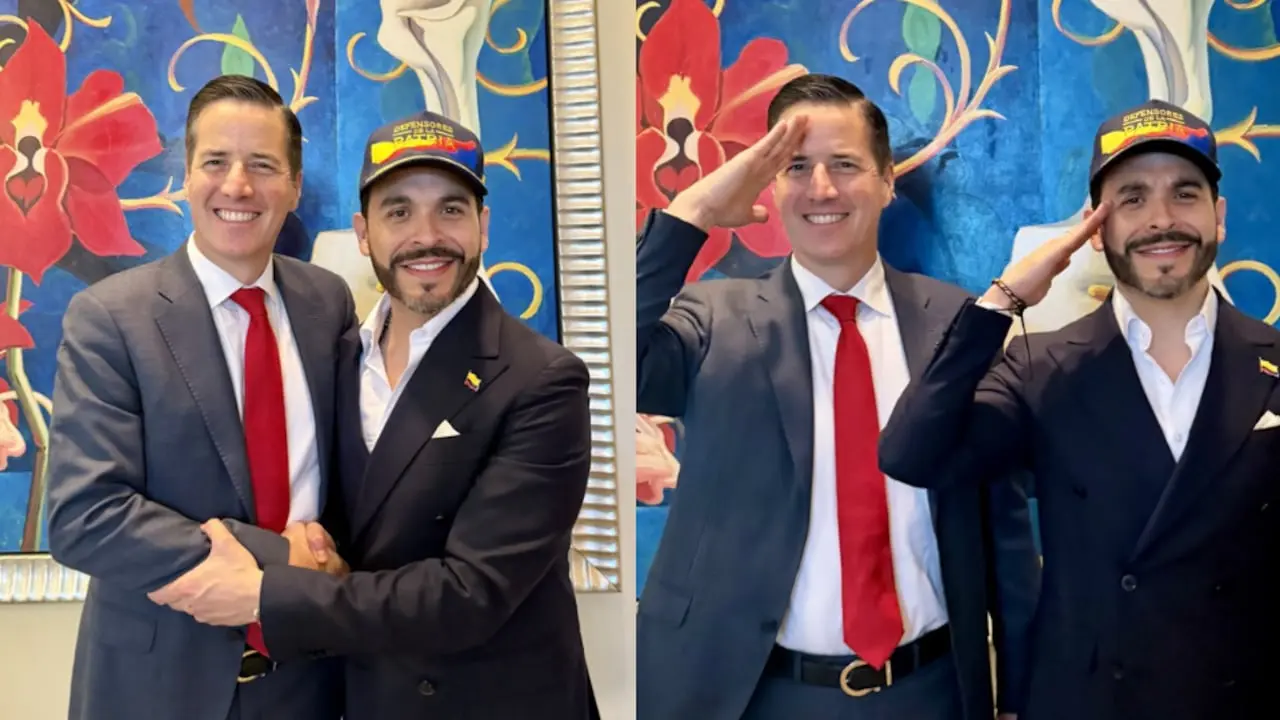
Featured image: De la Espriella with Colombian-born Republican Senator Bernardo Moreno. Source: Nueva Democracia
Nueva Democracia writes that this year marks 216 years since the beginning of the struggle for independence against the Spanish crown, and that yet, these years have been nothing more but the transition from colonial to semi-colonial conditions, with the networks of economic, military and political domination that comes with it.
This can be seen in how the previous governments’ economic approach, was the export of unprocessed primary products such as unroasted coffee, fresh bananas, flowers, and crude palm oil, sold to foreign imperialist countries for much less than what the country buys or receives back through trade. Nueva Democracia writes, that since 1990 the country’s ruling classes have agreed that the “best industrial policy, is no industrial policy at all”. They also write that the products and project financing from imperialist countries is not a gift, but an investment, by which, in exchange for capital, the profit resulting from the investment into the exploitation of natural resources and local labor, goes back to the countries of which the capital originated. 22% of foreign direct investment comes from the US, but countries like Spain, France, Switzerland, and the UK also play a significant role.
Nueva Democracia also raises the question of tourism, where people from the imperialist countries come to Colombia, an influx of people with capacity to pay significantly higher prices for property and goods, driving the prices up for the local residents and causing the gentrification of neighborhoods. These tourists also come as part of the vile phenomenon of sex tourism, where “Colombia’s lack of sovereignty, the power of the US passport, the power of the dollar, and the abject poverty of the Colombian masses enable foreign criminals to exploit the needs of poor women, teenagers, and children, who are perceived by the colonial gaze of these criminals as sexual prey” as Nueva Democracia writes.
Another integral consequence of the semi-colonial conditions is the reverse phenomenon – the migration from the oppressed countries to imperialist countries, a phenomenon that has seen an increase in Colombia –, with remittances received in the country growing by 10.6% in 2025 compared to the previous year. People migrate to imperialist countries to work, and to send remittances back to their families in their country. This too, reinforces the semi-colonial character of the country, tying the workforce further to that of the imperialist nations. Per now, remittances sent from imperialist countries represent 3% of the countries GDP, and mainly come from the US.
While the former government focused on the export of agricultural goods, the newly elected Abelardo de la Espriella, a US citizen, “hopes to further strengthen semi-colonial ties through mining and energy exports, an approach more aligned with that of the current US President Donald Trump” Nueva Democracia writes.
Nueva Democracia writes further that “Yankee imperialism is soundly defeated in the Middle East and seeks to cling with its claws to its ‘backyard’ in the hemisphere.” noting that this alignment of the current president with Yankee imperialism will serve as a way to weaken the grasp of Chinese social-imperialism on the continent.
Finally, Nueva Democracia emphasizes the strong military subservience of the Colombian State to Yankee imperialism. The State describes this subservience as “cooperation”, but US strategic interests prevail in this “cooperative” relationship, and historically this so-called cooperation has had a strong element of counterinsurgency tied to it, now under the guise of combating “narcoterrorism”. Nueva Democracia writes that “thus, the Colombian State as a whole is complicit in the US intervention in the fight against the ELN, especially at the Colombian-Venezuelan border, a fact confirmed by outgoing President Gustavo Petro”.
Concluding, Nueva Democracia writes that “With this military boot firmly in place […] the Colombian nation and people cannot truly celebrate their independence. On the contrary, this should be an opportunity to fight for sovereignty. […] It is the people’s task to strengthen this path of struggle against imperialism, to create a strong, dignified, and hunger free nation, drawing lessons and inspiration from the historical experiences of emancipation of the Soviet, Chinese, Palestinian, Vietnamese, Cuban, Indian, Peruvian, and Filipino peoples, among others, and encouraging other peoples of the world to do the same.”