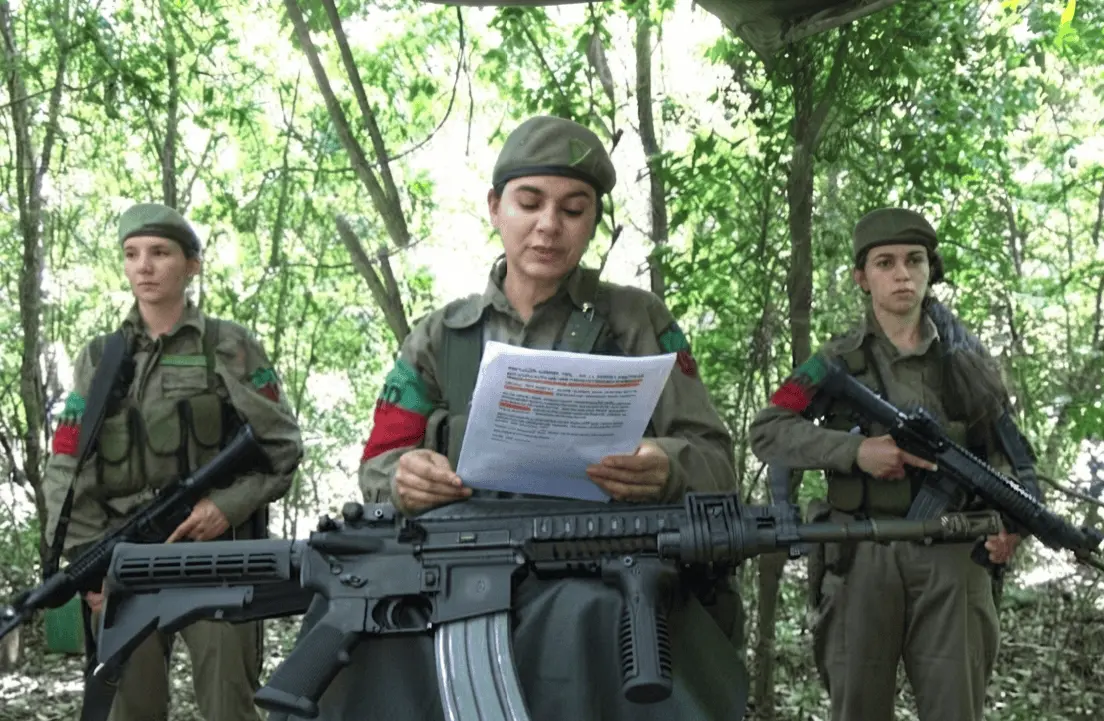
AND: After 12 years of failure against EPP guerrillas, the Paraguayan Army is called a “joke” and a “disgrace”
We hereby share an unofficial translation of an article published by A Nova Democracia (AND) on September 14.
After 12 years of operations and tens of millions of dollars spent by the old State, the Interior Minister promised to defeat the EPP by 2028; the Minister of Defense acknowledged that the mission had not been accomplished and blamed the dense jungle.
Paraguay’s reactionary Interior Minister, Enrique Riera, promised on August 28 to defeat the Paraguayan People’s Army (EPP) and locate three missing persons before the end of his term in August 2028. This new promise grants two more years to the repressive forces, which, after 12 years of operations and (at least) 68 million USD spent, have failed in their disgraceful mission of annihilating a contingent that the old State itself reduces to “about 14 guerrillas.” In light of this paltry result against the revolutionaries, lawyer and criminology professor Juan Martens stated that the reactionary Paraguayan Army and the Joint Task Force (FTC) are “a joke” and “a disgrace.”
Waging an armed struggle for 18 years, since its founding on March 1, 2008, the EPP has been a thorn in the side of successive governments, big landlords, and all manner of reactionaries on the “Island Surrounded by Land,” as the country was nicknamed by the Paraguayan writer and democrat Augusto Roa Bastos. Neither numerical and military superiority, nor the hefty budget allocated to the Internal Defense Operations Command (CODI) has yielded the result so often promised by the State.
In an interview with radio station La Tribu 650 AM, Riera reiterated his counterinsurgency vows, stating that the government possesses information about the EPP and has informants in the region. The minister presented the defeat of the guerrilla group as a “personal and governmental commitment,” and promised to locate former Vice President Óscar Denis, noncommissioned police officer Edelio Morínigo, and Félix Urbieta, who disappeared in 2020, 2014, and 2016, respectively, in actions attributed by the old Paraguayan State to the EPP.
Enraged, Riera continued his threats and turned against the families of the guerrillas living in exile, particularly against members of the Villalba family residing in Venezuela. “The Villalba women who are in Venezuela know where they are. Venezuela is in a difficult situation and we need to find other ways to bring them back. We have found them three times. The second group that is in the jungle knows, and that new generation that kidnapped Almir [ Almir de Brum da Silva ] also knows, and we believe they can be apprehended,” barked Riera. The threat targets the same family against whom the repressive forces already murdered Lilian Mariana Villalba and María Carmen Villalba, both 11 years old , in September 2020, and made Carmen Elizabeth Oviedo Villalba, known as Lichita, then 14 years old, disappear.
When interviewed by the Paraguayan newspaper ABC, Juan Martens stated that the inability to neutralize a supposedly small group cannot be attributed to a lack of resources, since CODI receives between 8 and 14 million dollars per year. For the criminologist, the failure may serve the very interests of those who benefit from the system: “Either they are useless, or the presence of these so-called armed groups is necessary and serves the interests of the military.” If, in 12 years, the Army and the FTC have failed to eliminate the EPP, he concluded, “then it’s a joke; it’s a disgrace.”
Military in the “Fight Against Crime”
The increased militarization of the Paraguayan countryside underscores the impotence of the old State. Originally, FTC operations were limited to the departments of Concepción, San Pedro, and Amambay, later extending to Canindeyú. This year, however, the military presence has reached all 14 departments of the Eastern Region, following the inclusion of Itapúa, Misiones, and Ñeembucú. “The security situation hasn’t changed, but the militarized territory has expanded,” Martens summarized. Thus, in its hunt for guerrillas, the FTC has also begun to assume civilian and police functions, guard prisons, and crack down on small-scale drug trafficking in cities.
Former Security Minister Cecilia Pérez, in turn, contested the expansion of CODI’s mandate, which shifted from a supposed role of “counterterrorism,” to one focused on combating “organized crime.” “First it was the drug traffickers, then it was the EPP, then it was the drug traffickers with the EPP,” she stated. According to Pérez, the government cannot claim to have weakened the EPP while simultaneously invoking its alleged alliance with “criminal organizations” to explain the increase of attacks. If the official claim (slander) itself were correct, she concluded, the guerrilla group reorganized, expanded its area of operation, and forged new alliances.
This slanderous association occurs while the lackey government of Santiago Peña follows the counterinsurgency playbook of the United States (US) to the letter and deepens its military submission to Yankee imperialism, after the approval of the Status of Forces Agreement , known by the English acronym SOFA, which opens Paraguay to the entry of US military personnel and equipment. This rebranding thus expands the territory and powers given to the reactionary Armed Forces, perhaps the reason why the Minister of Defense, Óscar González, refuses to admit defeat. Although he acknowledged that “the objective has not been fully achieved,” he declared that, had the operation failed, there would be “terrorists” planting bombs in shopping centers in Asunción. As for the inability to locate the guerrillas, he blamed the dense jungle.
The struggle for land is the flame that fuels the insurgency.
The most recent incident attributed by the government to the EPP occurred on July 21 in the Naranjito settlement, where two police officers and a resident died during an armed attack. Riera declared that the episode would be met with “the full weight of the State and the law.” The response came less than a month later, but not against the EPP.
Responding to the alarm raised by big landlords, who claimed that “radicalized peasants” were supporting the fighters and turning the settlements into “guerrilla zones,” the old State launched the so-called “Operation Renaissance” against the Primero de Marzo settlement. The offensive mobilized more than 300 agents of the repressive forces and nine prosecutors across a peasant area of almost 7,000 hectares, where hundreds of families are fighting for land regularization.
Despite the military offensive by the old State and the high budget allocated to combat the EPP revolutionaries, a survey conducted by AND, based on journalistic articles and public security reports from Paraguay, shows that, throughout the conflict, the repressive forces suffered significant casualties, including 20 police officers and 14 soldiers eliminated in ambushes and confrontations, demonstrating that the government’s numerical, military, and financial superiority does not translate into strategic victory on the ground. In contrast, counterinsurgency operations carried out by successive governments have resulted in limited neutralization, accounting for approximately 20 fatal casualties in the ranks of the EPP since 2008, while the conflict continues to take a heavy toll on civilian lives, with more than 40 deaths recorded among peasants, indigenous people, residents of the northern region, as well as family members of the guerrillas, such as the criminal murder of the two Argentine girls, Lilian Mariana Villalba and Maria Carmen Villalba, both 11 years old, on September 2, 2020, in addition to the forced disappearance of Carmen Elizabeth Villalba, known as Lichita.
The militarized region is also home to one of the world’s largest concentrations of land ownership. The president of the National Institute for Rural and Land Development, Francisco Ruiz Díaz, himself acknowledged that the country is experiencing “the greatest concentration of land ownership in the entire history of Paraguay.” In 122 years, the old State acquired almost 5 million hectares, but transferred only 5% to peasants. According to the 2022 Agricultural Census, properties larger than 1,000 hectares concentrate 77% of the country’s agricultural land, approximately 23.4 million hectares, while the National Peasant Federation estimates that more than 300,000 peasants lack access to land.
The EPP, officially founded in northern Paraguay in 2008 as a splinter of the Partido Patria Libre (PPL), emerged from within the peasant resistance movement. After the dismantling of the PPL, some of the guerrillas reorganized under the leadership of figures such as Carmen Villalba, asserting that the institutional path had failed. The organization denounces the “agrarian reform” promised by the various governments as a farce. The group, which is proletarian in character, defines itself as Marxist-Leninist and operates mainly in the departments of Concepción, Canindeyú, and San Pedro. For the EPP combatants, revolutionary armed struggle is the only possible response against the latifundium.
We have previously reported on the increasing political repression from the State of Paraguay: