Tjen Folket Media – Kenya: Interview with Revolutionary Youth
We hereby share an unofficial translation of an interview published by Tjen Folket Media, from Norway, on the 27th of May.
A contributor to Tjen Folket Media attended the Pan-Africanism Summit Against Imperialism (PASAI) in Nairobi, Kenya, on May 11 and 12. PASAI was organized as a protest against the “Africa Forward” summit organized by French imperialism and the Kenyan state. We will be publishing a series of articles written during this trip.
Tjen Folket Media met with several members of the youth organization of the Marxist Communist Party – Kenya (CPM-K) during our visit to Nairobi in May. They explained to us that the Revolutionary Youth League (RYL) is an organization, a mass body, of and for the party.
The Youth League goes to the cities and the countryside to reach out to young people among the workers and peasants. They have their own projects, such as designing propaganda materials for the party.
Several of those we spoke with said that youth unemployment in Kenya is sky-high, but that the figures are unreliable. The official figures do not reflect the reality in Kenya’s major cities. They further explained that there is a legally mandated minimum daily wage equivalent to 40 Norwegian kroner, but that many employees earn much less than this. [According to https://wage.is/kenya/, the minimum wage is approximately $4 a day—about 40 kroner—while the actual median income is about a quarter of that, or 10 kroner a day, ed. Note.]
Due to high unemployment, a great many young people in the cities work in the informal economy and rely on so-called “gigs” (odd jobs) to survive. The activists also explain that ordinary citizens who occasionally come into a little money invest in a car and hire someone to drive for Uber or Bolt. In such cases, a common arrangement is that the driver must pay the car owner 2,000 Kenyan shillings per day, regardless of how many or how few trips are made that day. The driver may well end up in the red on a given day if he gets few rides. Time and again, the activists also emphasize that there is no “social safety net” in Kenya.
They say that the privatized and chaotic transportation sector creates many problems for the masses, and that in bad weather, owners may keep buses and cars off the streets in order to raise fares. Fares are often negotiated on a trip-by-trip basis. The activists say that there used to be a public bus company in Kenya, but that it was privatized—in line with a general trend toward more privatization and more crisis in Kenyan society.
In this sense, the revolutionary youth confirm that the concept of “developing countries” is a myth spread to give the impression that imperialism means progress for both imperialist and oppressed countries. The reality is that imperialism means reaction across the board, and that exploitation is constantly deepening in the oppressed countries.
The old public bus company has largely been replaced by “matatu buses.” An activist tells us that to maximize profits in this industry, trucks and vans are imported from China and converted in Kenya into buses that can carry dozens of passengers. These are neither safe nor designed for comfort.
They also tell us that similar problems apply to waste management. There is trash everywhere, and organized criminals have monopolized garbage collection. The result is illegal landfills and trash piling up in the back alleys. The activists say this is a result of Kenya’s status as a semi-feudal and semi-colonial country.
They go on to say that textile waste is a unique problem. Clothing donated in Europe—for example, as “emergency aid for Africa”—is channeled to Kenya. There, the shipments are hijacked, the activists say, and the clothes are sold at rock-bottom prices. They are often sold wrapped in plastic, so that buyers don’t know what they’ve actually bought until they unwrap them—and by then, much of the clothing is often completely unusable, the activists tell us.
The Mtumba industry (or “mitumba”) refers to the trade in used clothing, and nearly everyone gets their clothes from it. These are clothes sold in “bundles” wrapped in plastic, and it is a massive industry in East Africa. The activists explain that this is, in practice, the dumping of surplus capital from imperialist countries, and that this both keeps prices high in the imperialist countries and makes it impossible to build a profitable local textile industry in East Africa. Kenya used to have such a textile industry, but partly as a result of dumping from imperialist countries, it has been replaced by foreign-owned industries that produce brand-name clothing for imperialist countries.
They go on to explain that Nairobi is home to Africa’s largest landfill, and that such landfills are also filled with industrial waste. They say that overproduction for markets in imperialist countries creates goods that go unsold, and that these quickly end up as cheap goods or trash in Africa. This applies not only to clothing, but also to used cars from countries such as Japan.
Tjen Folket Media also conducted its own interview with “Kamaradi,” who is responsible for political education within the youth league. He, too, begins by telling us about the context in Kenya, because this is the foundation of their work. He says Kenya is neocolonial and semi-feudal, and that this applies to all African countries, especially those south of the Sahara.
Kamaradi says that the imperialists use the compradors—the local imperialist lackeys—as their tools, and that the oppressed countries are not capitalist in the true sense of the word. They end up as consumers, not producers, of industrial goods. The majority live in rural areas and are kept down in a semi-feudal system. The economic basis here is the land, which is monopolized by big landlords and big monopolies. Thus, he says, the country must first be liberated from colonialism and feudalism before it can march on toward socialism and communism.
He goes on to say that 70% of the population consists of children and youth. His most important task is to organize the youth to fight for Kenyan and African independence and sovereignty.
The Revolutionary Youth League works to recruit young people in rural areas and cities, while Kameradi focuses primarily on providing structured political education on behalf of the party. He develops study plans and curricula. He explains that the party’s platform strongly appeals to young people, and that his task is to further educate them in Marxism.
Kameradi says that the neoliberal educational program within bourgeois educational institutions only trains young people for hopelessness. This system is dysfunctional, he explains, but it teaches young people to blame themselves for their suffering and the problems in society. In contrast, the revolutionaries explain that the problem is the system. The system merely prepares young people for wage slavery or to become part of what Marx calls the reserve army of labor—that is, the vast mass of unemployed people who help keep wages extremely low.
Kameradi goes on to tell us that an important task in the education of young people is to combat liberalism and opportunism, and to guide the discussions among them. He visits local collectives of revolutionary youth and emphasizes that it is crucial to organize and that he applies the mass line in his work.
He also says that a major obstacle is bourgeois ideology, which promotes short-sighted thinking and opposes rationality and science. A central point in political education is to combat such thinking and replace it with the class standpoint of the proletariat, materialism, and strategic thinking.
Another problem he describes is State persecution. The State, of course, tries to prevent revolutionary organizing that demands political power. Other parties and organizations do nothing for the masses, he says, and since the revolutionary movement is a threat to the ruling class, it becomes a target for repression, and the State is militarized to intensify the suppression.
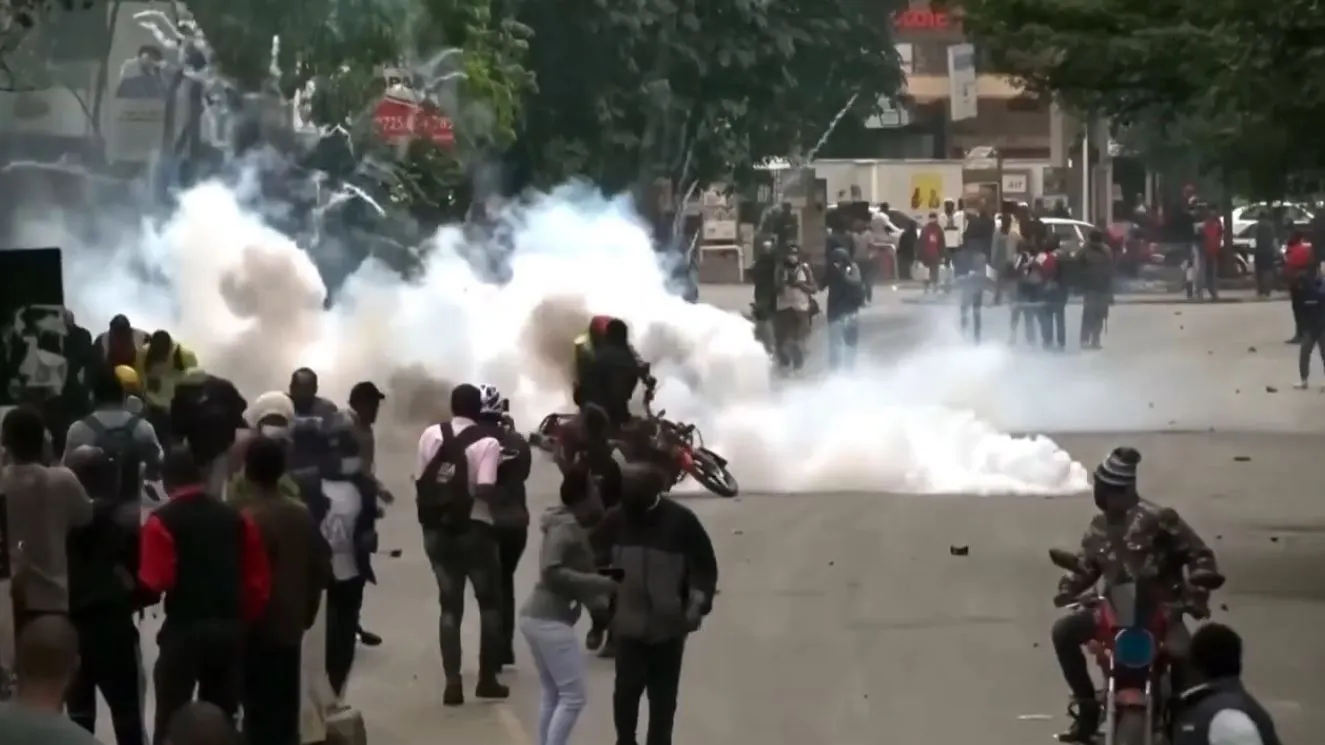
Despite these problems, Kameradi describes an explosive situation among the masses. This is expressed in riots, strikes, and protests, such as the uprising against the 2024 budget. These struggles mobilized and politicized large masses of Kenyan youth, and involved both the storming of parliament, the killing of over 20 people by security forces, and the president’s withdrawal of his unpopular bill—which was initially the result of pressure from the International Monetary Fund (IMF).
The revolutionaries united with the masses in these struggles and have since worked purposefully to raise consciousness among the youth. Kameradi states that “NGOs” [“voluntary” organizations and “aid organizations,” often funded by imperialist states, ed.] constitute yet another obstacle to the organization and struggle of the masses. These organizations deceive the masses and spread reformist illusions, but what is needed, says Kameradi, is revolution.
“NGOs” are designed to deceive the masses, he asserts, and “NGO-ism” is a major problem that allows certain individuals to profit from activism and spread the idea that working within the system can improve society. Kameradi asks rhetorically, “Where does their money come from?” and “Who pays?” In short, these instruments of the bourgeoisie serve to further cement oppression and keep individuals content with “a small piece of the pie.”
Kameradi concludes by recounting his own experiences at the university, where professors claimed that Kenya is a “developing economy” and where bourgeois politicians pit “masses against masses” and divide people along lines of gender, religion, and tribe. Kameradi describes an “identity crisis” among the students and believes this is created more or less consciously by the system. This prevents many intellectuals from seeing their own role and taking on their own responsibility in the national-democratic revolution.
Kameradi concludes by stating that the imperialist rulers of the world are driving the world into barbarism and savagery, and emphasizes the necessity of revolutionary and anti-imperialist struggle.
We have previously covered the Kenyan PASAI interview series being published by Tjen Folket Media. You can read more here: