Brazil: 9th Assembly of the Mura People Reaffirms Resistance against Imperialist Mining in Autazes
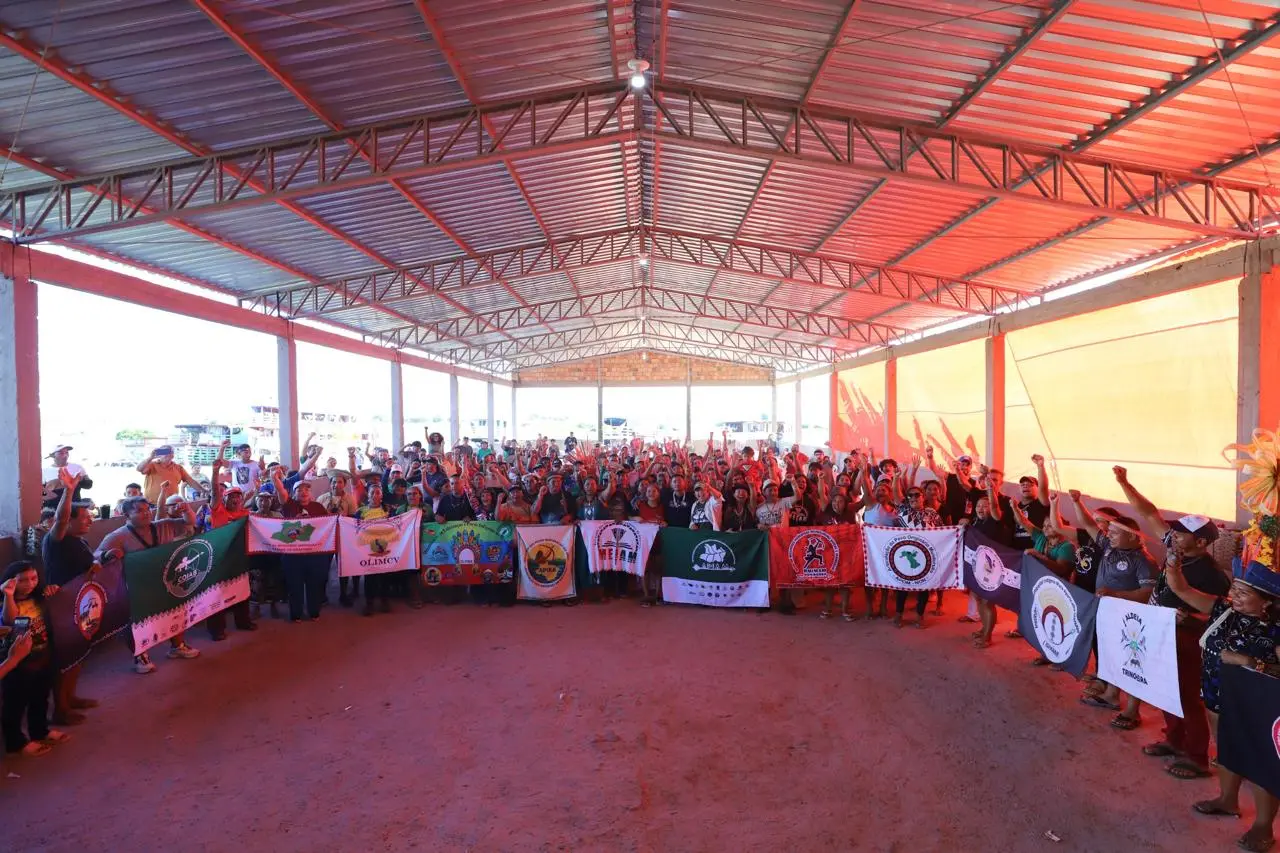
Featured image: Mura people reaffirm their path of resistance. Source: AND
A Nova Democracia (AND) reports that more than 500 indigenous peasants gathered on the 9th and 11th of July, in the Capivara Village in Autazes, in the Amazonas interior. The peasants gathered for the participation in the 9th Assembly of the Mura People, in which “We Continue to Be the Answer” was the theme of the meeting. Participating in the assembly was the Mura people and other indigenous peoples as well as other popular organizations.
AND writes that “among the main topics discussed were the leading role of indigenous youth and women, natural gas exploration in the municipalities of Silves and Itapiranga, the privatization of the Madeira River, illegal mining in Indigenous Lands, and potassium mining in the Autazes region.”
Professor Herton Mura, interviewed by a local AND correspondent, highlighted “the solidarity of peoples of different ethnicities” and stated that the assembly demonstrated that attacks on indigenous rights goes beyond the Mura people, highlighting also the urgency of the resumption of the demarcation of indigenous lands in the region: “At this 9th Assembly, we realized that it’s not only the Mura people who are interested in fighting against the setbacks to the rights of indigenous peoples, especially those who live in this region of the lower Madeira River. […] in addition to the mining issue, there are several other problems such as the advance and expansion of livestock farming, especially buffalo cattle farming, which is an animal that destroys the natural habitat, mainly rivers, destroys the flooded forests, springs, and also the sanctuaries where fish reproduce, thus causing major impacts on the food security of all the people, not only the indigenous peoples but also all the peoples who live in the region.”
AND writes that the assembly was a success due to the bringing together of hundreds of indigenous people, the strengthened unity against so-called “large projects,” and the reaffirmed resistance to the advance of mining, illegal prospecting, and latifundium on indigenous territories.
AND writes that traditionally, the Autazes region has had an economy mainly involving agriculture, specializing in dairy products, but with the potassium exploration project – headed by a subsidiary of Brazil Potash, Potássio do Brasil Ltda. – in territory claimed by the Mura people, the dynamics have been altered.
Potássio do Brasil Ltda. is, despite its name, controlled by foreign capital, originally created in 2009 by Canadian firm Forbes and Manhattan, with the largest shareholder today – with 34% of the shares – being CD Capital, a London-based fund specializing in mining.
AND writes: “The company presents the project as a way to reduce Brazil’s dependence on fertilizer imports, but Mura leaders and popular organizations denounce violations of territorial rights, environmental risks, lack of adequate prior consultation, co-opting of leaders, and a direct threat to indigenous communities.”
The conflict has become known as the Autazes Potassium War. In it, pressure from foreign mining companies, the actions of the old State apparatus, disputes over prior consultation, and indigenous resistance permeated the lives of the Mura people in the region.
Indigenous people and popular organizations have also denounced the lackey government of Lula and the Workers Party (PT). Specifically, Sinésio Campos, the state president in Amazonas, for his role in lobbying in favor of mining, falling in line with a recent statement from Lula, where he stated that “Brazil needs the potassium that we have, and we have to know how to exploit it without causing damage to the environment.”