New developments in the war in Ethiopia
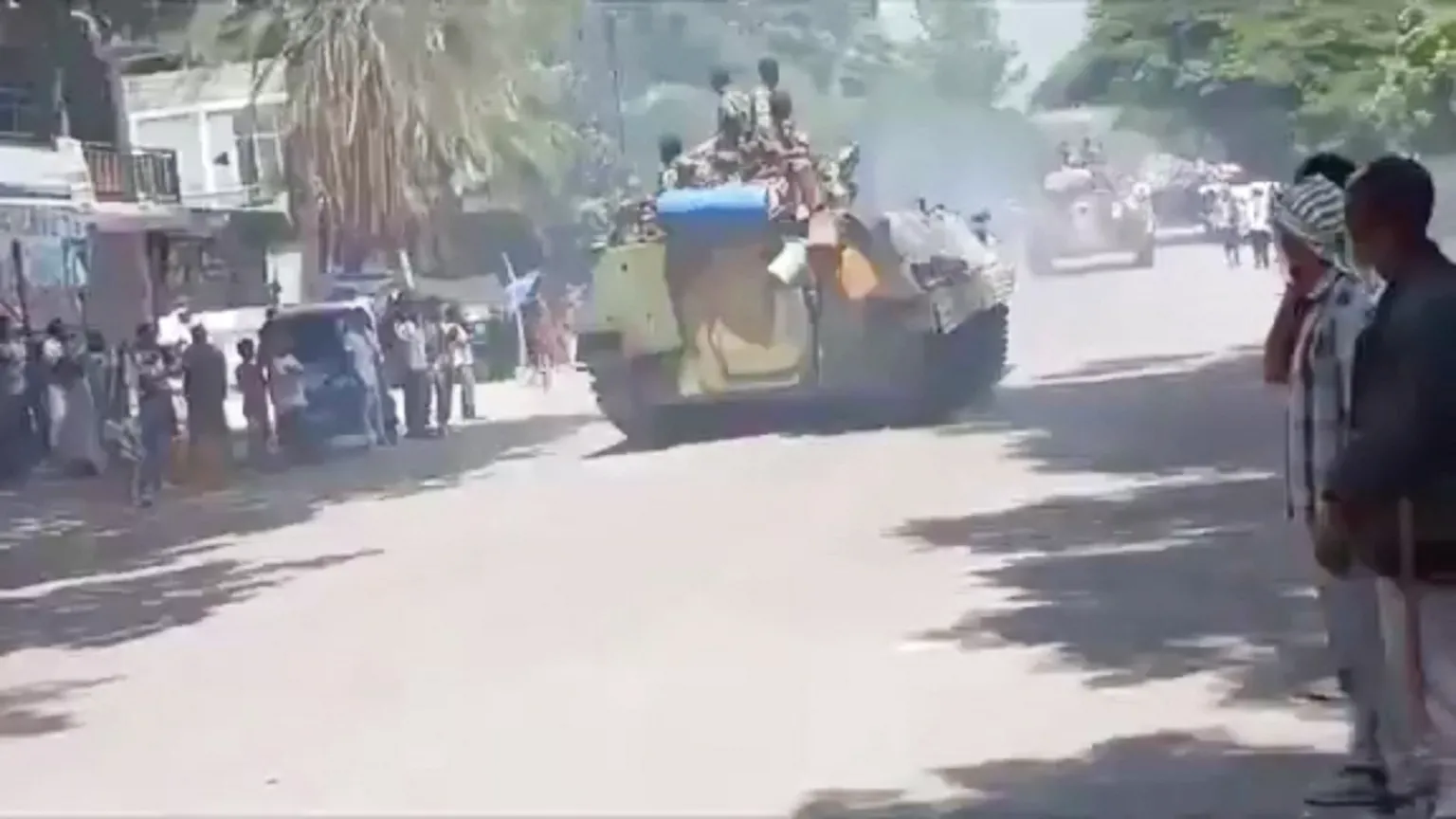
Featured image: Tanks and armoured vehicles passing through Alamata in Tigray region after days of clashes Source: BBC
Ethiopia has experienced continuous conflict and serious atrocities – some of which we have previously reported 1 2 3– fighting has escalated again this year. Opposition forces have formed a political and military alliance called the Ethiopian Peoples’ Forces Alliance for Survival against the federal government.
The federal government, led by the Prosperity Party, and the prime minister is Abiy Ahmed Ali, has fought several regional insurgencies against the central government. Regional forces have also attacked federal forces and fought against rival armed groups. These conflicts began at different times and have developed along several separate fronts.
Since the beginning of the year, fighting has resumed between the Tigray Defence Forces (TDF) (of the Tigray People’s Liberation Front (TPLF)) and Ethiopian National Defence Force, with Amhara militias supporting the federal side. Both have accused each other of violating the 2022 Pretoria Agreement, which ended the active phase of the Tigray War. In August and September, the TDF reportedly mobilized forces and heavy weapons in southern Tigray. Federal forces carried out drone strikes against Tigrayan positions and officials. Armed clashes were also initiated around Shererina, near the Ethiopia–Sudan border.
The federal government is attempting to reduce the number of non-State armed groups and forces, and strengthen its control over taxation, mining, and other resources. This has contributed to regional conflicts. Many of the forces represented in the new Alliance for Survival control regional resources, while some are also involved in illegal mining, tying the conflict to competing claims over Ethiopia’s wealth and resources.
The Alliance for Survival
On September 20, seven organizations announced the formation of the Ethiopian Peoples’ Forces Alliance for Survival. The organizations are the Amhara Fano National Movement; the Tigray People’s Liberation Front (TPLF); the Oromo Liberation Army (OLA); the Ogaden National Liberation Front (ONLF), representing the Somali/Ogaden region; the Afar Revolutionary Democratic Unity Front (ARDUF), also known as Ugugumo; the Benishangul Peoples’ Liberation Movement (BPLM); and the Gumuz Peoples’ Democratic Movement.
The Alliance’s statement describes Abiy Ahmed’s government as “anti-people.” It accuses the government of becoming “a mercenary of foreign powers,” selling out the interests of Ethiopia’s peoples, and turning the country into a subservient and dependent State. Although the statement is not precise on this the fact is that this refers to the influence of imperialist powers or their regional lackeys such as Eritrea and the United Arab Emirates, both of which have played roles in arming and intervening in conflicts inside Ethiopia.
The Alliance’s two principal demands are the removal of Abiy Ahmed’s government and the establishment of an inclusive transitional government. Its statement declares:
“Accordingly, we, the peoples’ forces concerned with the survival of Ethiopia’s peoples, bear the historic responsibility of overthrowing this regime, safeguarding the survival of all nations, nationalities and peoples, and opening a new chapter. The historic mission and first objective of the peoples’ forces is to defend ourselves collectively against the devastating war declared upon us; remove Prosperity’s [Prosperity Party, the leading Party in Ethiopia] personalist and dictatorial system, which has endangered the survival of our peoples and the security of the country; and bring about the establishment of an inclusive transitional government guided by a transitional charter. In doing so, we seek to open a new transitional chapter in which the human and democratic rights of all Ethiopians can be guaranteed in full, without diminution.”
Source: Martin Plaut
Recent escalation
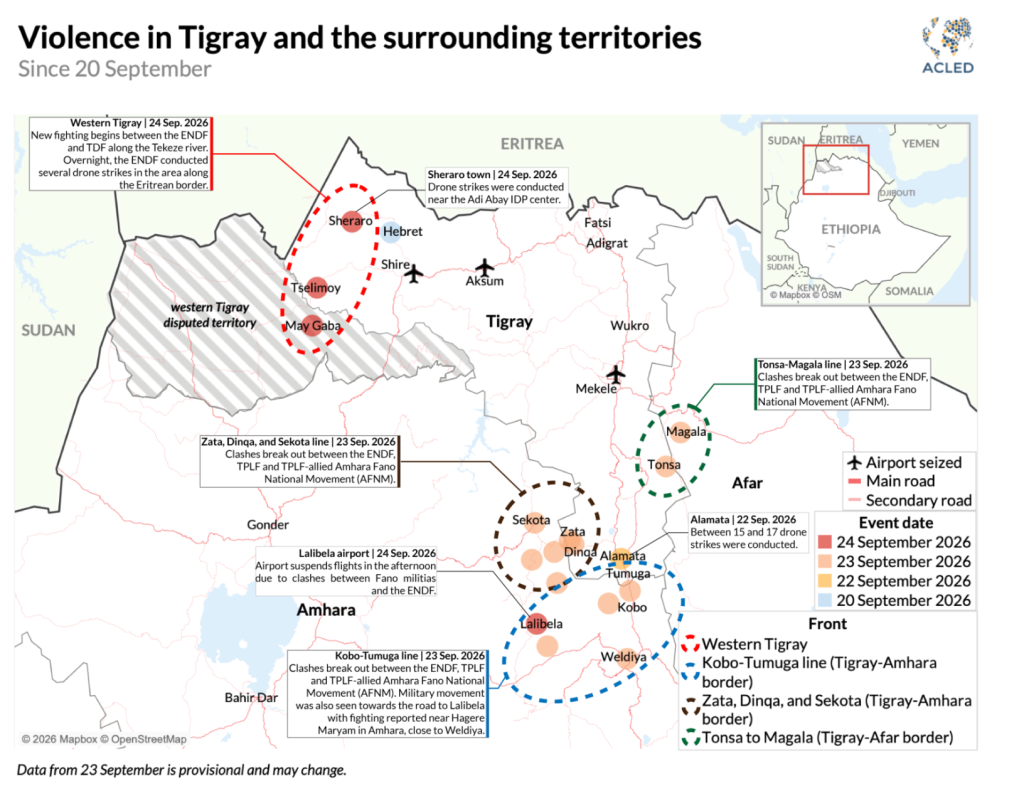
On September 23, Tigrayan forces reportedly advanced into parts of Afar’s Zone 2 and seized control of airports in Mekelle, Axum, and Shire. Fighting also broke out along the Tigray–Amhara and Tigray–Afar fronts, involving the TDF, Fano, Afar forces, and the Ethiopian National Defense Force (ENDF). This was described as the sharpest escalation since the Pretoria Agreement.
The following day, fighting reportedly spread beyond Tigray’s immediate boundaries into Amhara, including areas near Lalibela, Wag Hemra, North Wello, and Raya Kobo. Flights to Lalibela were suspended.
On September 25, Fano claimed to have captured Ethiopian army officers and military vehicles in Amhara. Clashes reportedly continued in Afar and Tigray, accompanied by reports of drone strikes.
On September 28, reports indicated further Tigrayan advances toward Afar and continued fighting in northern Ethiopia.
TPLF spokesperson Michael Asgedom said that the organization’s cooperation with other opposition factions was both political and military. He told the Associated Press that joint “military operations may become necessary to achieve the objective of removing the dictatorial regime.” When asked whether the TPLF’s participation in the Alliance violated the 2022 peace agreement, Asgedom said that the agreement was “no longer valid.”
Imperialism and the Horn of Africa
The Ethiopian State remains dependent on foreign loans (around 28.1% of GDP), aid, military support, foreign exchange, and external investment. At the same time, it is subject to imperialist interests from multiple directions. Ethiopia is strategically located in the Horn of Africa, near the Red Sea, the Gulf of Aden, and major routes linking Africa, the Middle East, Asia, and Europe. Control or influence over this region affects shipping, military access, and trade.
These routes have become even more strategically important as the advancement of Ansar Allah, the Yankee war of aggression against Iran, and other regional developments disrupt trade. 12-15% of global maritime trade and around 30% of global container traffic passes through this corridor.
Yankee imperialism has strategic interests in the Horn of Africa, including the export of capital through factories, technology, infrastructure, and foreign aid. Ethiopia has also been important to US “counterterrorism” strategy.
Chinese social-imperialism is also seeking to expand its influence through infrastructure, technology, and mining. The European Union’s Global Gateway initiative is likewise competing over capital exports, trade routes, infrastructure, and technology, with the aim of creating more market opportunities for European capital. Ethiopia’s mineral resources may also become increasingly important to European imperialist powers.
Imperialist exploitation has shaped the conditions in which internal conflicts develop through militarization, “counterterrorism” and “security” partnerships, infrastructure projects, access to resources, aid, and other forms of capital export. Imperialist powers have also benefited from ongoing conflicts in the Horn of Africa, as instability creates opportunities to expand the export of capital through “aid”, reconstruction, infrastructure, and security partnerships.
Political contradictions within the Alliance
Rather than a joined political program the participants represent different sectors and even factions of the former rulers of the federal government.
The organizations in the Alliance are united mainly by their opposition to Prime Minister Abiy Ahmed, rather than by a shared political program. They disagree over territorial claims – especially Western Tigray/Wolkait-Tsegede – as well as Ethiopia’s federal structure and regional autonomy.
The Alliance also faces disputes over representation and signatures, separate military commands, mistrust between former enemies, and the possibility that individual factions could negotiate separate peace agreements. These unresolved conflicts could cause the Alliance to fragment or create new conflicts even if it succeeds in weakening the federal government.
The right of self-determination, together with popular demands for land, security, and livelihoods, reflects legitimate grievances among the Ethiopian masses. The federal government is guilty of murder, repression, rape, forced displacement, and drone attacks against civilians. Rebellion against this is justified but currently there are no indications the Alliance will actually lead this struggle in the fight for the popular demands, resisting instrumentalization from imperialist actors. A People’s Army, led by the proletarian vanguard, is what the People of Ethiopia so urgently need.
Conclusion
Conflicts involving Ethiopia, Eritrea, and Sudan could further fan the flames of the already burning Horn of Africa, with multiple conflicts, including a war in neighboring Sudan – The region from Horn of Africa to Iran is an uninterrupted war zone. Yankee imperialism is afraid of this widespread instability, which a civil war in Ethiopia would increase. It wants to protect its strategic positions and interests, masking it as a humanitarian effort.
If the Alliance for Survival can survive its inner contradictions, it can weaken the federal government that is led by long time US-backed Abiy Ahmed. While the people are paying the price of these conflicts that are based on imperialist domination of the region, they also show that imperialism cannot continue their domination as before.