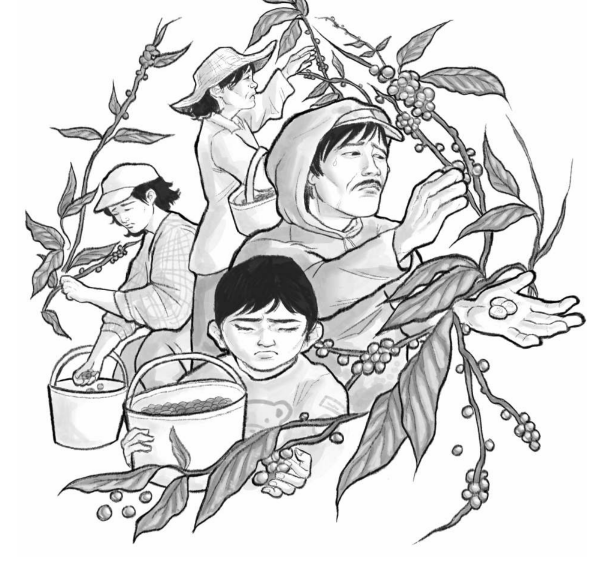
Philippines – Ang Bayan: A Bitter Life for Sultan Kudarat Coffee Farmers
We hereby share an article published in the latest issue of Ang Bayan, from August 21.
The Senate formally declared Sultan Kudarat the “coffee capital” of the Philippines in 2023. The province produces the largest volume (35%) of the Philippines’ commercial coffee. Coffee is planted on more than 20,000 hectares of its productive land.
The reactionary government has in recent years touted the supposedly “world-class” robusta coffee produced by the fertile soil and cool climate of the Daguma mountains and the ancestral lands of the T’boli and Dulangan Manobo. It launched programs to “raise farm productivity,” built farm-to-market roads to “facilitate” the transport of products and cleared thousands more hectares for additional coffee trees. All these efforts focus on increasing the profits not of farmers, but of big businesses and their bureaucrat partners.
The truth is, life is bitter for coffee farmers in Sultan Kudarat. Landlessness and the lack of regular work are widespread among them. Their income falls far short of what they need for food and basic necessities. Social services are scarce especially for families in remote areas. They are among those with the highest poverty rates.
Most of the province’s coffee production is small-scale. Each family cultivates an average of one and a half hectares. Production costs are high, with pesticides and fertilizer alone costing as much as ₱18,000 [Editor’s note: Philippine peso. 1 USD is equal to 62.01 Philippine pesos] per harvest cycle. One study found that maintaining and harvesting a one-hectare robusta coffee farm requires ₱27,000–₱48,000 in capital. To cut costs, the entire family, from children to the elderly, takes on the clearing, maintenance and harvesting of the farms.
The coffee harvest season lasts only four months, from October to January. Depending on weather conditions, farmers earn ₱22,000–₱47,000, or ₱5,500–₱11,750 per month. The entire family must find other work to survive during the next eight months, from February to September.
One of these farmers is Pepe, married and with three children. He owns a little over two hectares of land planted with robusta coffee. He works as a grass cutter on larger coffee and corn farms during the months without a harvest.
Coffee farms near the barangay pay him ₱300–₱350 a day for eight hours of work (without food). Plantations in the mountains or a remote area pay him ₱200 a day, with free lunch. This falls far short of the ₱433 daily minimum wage set by the state for agricultural workers in the region. It is even farther from the ₱1,200 a day that a family of five needs to live decently.
Daily wage insufficiency forces Pepe to borrow money from his employer. A large portion of his income goes to paying off his debt when harvest comes.
Nestle Philippines monopolizes the production and pricing of small farmers’ harvests because it is the biggest buyer of local robusta, which it uses for the Nescafe brand. The company buys more than 70% of the country’s total coffee harvest and 80% of the harvest in the Soccsargen region. Its standards dictate prices, which are in turn based on fluctuations in the global market. In 2025, Nestlé Philippines earned $3.2 billion from local coffee sales.